• My first round entry in the Stat Geek Idol contest was about using decision trees to predict teams that would make it to the Sweet Sixteen.  Now that we are down to sixteen teams remaining in the tournament, let’s review how the model performed.

    Let’s start out with what I consider to be the most impressive results.  In the article, I stated, in the conclusion:

    So the moral of the story is don’t get too excited about Florida State (even though they just won the ACC) or Michigan, and if you’re looking to pick an impressive upset, just about any of the fourteen seeds will do.

    The second half of this sentence makes me look bad as I singled out the only seed other than 16 not to win a first round game.  But I don’t think I was the only one to make this mistake.  Plenty of people were really excited about Belmont.  Alternatively, in the first half of the sentence I chose Florida State and Michigan as teams to not make it to the Sweet Sixteen based on the model results.  Now, by itself, it’s not too impressive to pick a team to NOT make it to the Sweet Sixteen (just pick a 16 seed every year), but these were two teams that, if they only beat lower seeded teams were expected to make it to the Sweet Sixteen.  Michigan lost in the Round of 64 and Florida State lost in the Round of 32 (after barely escaping the first round).  This means that in the last six years no team with an overall RPI rating between 0.6169 and 0.643 with an opponent’s effective possession ratio greater than or equal to 0.9147 and an average second half scoring margin of less than 2.998 has ever made it to the Sweet Sixteen.  These teams are 0 for 11.  That’s kind of interesting.

    Large RPI teams

    In the article I said:

    So what about this year teams? There are 6 teams in the tournament this year that fall into group R1. These teams are Kentucky (1), Michigan State (1), North Carolina (1), Syracuse (1), Kansas (2), and Duke (2). These are the high Overall RPI teams that almost always advance to the Sweet Sixteen.

    Group R2 only contains one team this year, Ohio State (2). Recall that in the last five years, all nine of the teams from group R2 have advanced to the Sweet Sixteen.

    Group R3, which has advanced 51.61% of the time over the past five years includes eight teams this year: Missouri (2), Marquette (3), Baylor (3), Georgetown (3), Louisville (4) [In the original article, I wrote eight teams and then only listed seven], Indiana (4), and Wichita State (5) and Memphis (8).

    Group R4 consists of Florida State (3) and Michigan (4). No team from group R4 has advanced to the Sweet Sixteen in the last five years. We’ll see if either the Seminoles or the Wolverines can snap the losing streak for R4.

    • Group R1 advanced 5 out of 6 (83.33%) teams this year with only Duke failing to make the Sweet Sixteen.  Historically (previous five years), 91.17% of teams in this group advance to the Sweet Sixteen.
    • Group R2 contained one team this year, Ohio State, and they did, in fact, advance to the Sweet Sixteen.  Ohio State is now the tenth team to fall into this category over the last six years and all ten of these teams have qualified for the Sweet Sixteen.
    • Group R3 had eight teams in it this year and historically 51.61% of teams in this group qualify for the Sweet Sixteen.  This year 4 out of the 8 (50%) qualified.  Marquette, Baylor, Louisville, and Indiana advanced while Missouri, Georgetown, Wichita State, and Memphis have been eliminated.
    • Group R4, as previously mentioned, contained two teams this year and both failed to qualify for the Sweet Sixteen.  In the last six years, no team from this group has ever made it to the Sweet Sixteen

    Small RPI teams

    In the article I said:

    So what about the small RPI teams this year? The tournament this year features nine teams in the group L2. These teams include St. Mary’s (7), Florida (7), Notre Dame (7), Creighton (8), Purdue (10), California (12), South Dakota State (14), Belmont (14), and Iona (14).

    The L3 group contains one team this year: BYU (14). 8 out of 12 teams in this group over the past five years have gone on to the Sweet Sixteen, however, BYU to the Sweet Sixteen this year seems unlikely as they are a 14 seed and have to win a play-in game just to get into the round of 64. I think it’s interesting that all these fourteen seeds fall into these categories with relatively high probabilities of advancing to the Sweet Sixteen.

    All of the remaining teams fall into the L1 category, which has advanced a little over 5% of its teams to the Sweet Sixteen. Some of the notable teams that fall into this group include Wisconsin (4), New Mexico (5), Temple (5), Vanderbilt (5), Murray State (5), Cincinnati (6), UNLV (6), and San Diego State (6). Also, in this group are Gonzaga (7), Kansas State (8), Iowa State (8), Alabama (9), Saint Louis (9), UConn (9), and Southern Mississippi (9).

    • Group L1 had 39 teams fall into this category (after the First Four had been played).  Historically, 5.34% of these teams make it to the Sweet Sixteen.  This year 5 out of 39 (12.82%) qualified.  This is a little bit higher than usual and is reflected in just how crazy this tournament has been over the first two rounds.  The teams that qualified from for the Sweet Sixteen from this group were Wisconsin, Cincinnati, Xavier, NC State, and Ohio.
    • Group L2 had nine teams this year and historically 17.86% of these teams qualify for the Sweet Sixteen.  Only one of these nine teams (11.11%), Florida, qualified for the Sweet Sixteen.  Interestingly, two of these nine teams were knocked out in the First Four.
    • Group L3 contained only one team, BYU.  8 of the 12 previous teams in the group qualified for the Sweet Sixteen, but with BYU’s loss, this group falls to 8 for 13 (61.5%)

    Cheers.
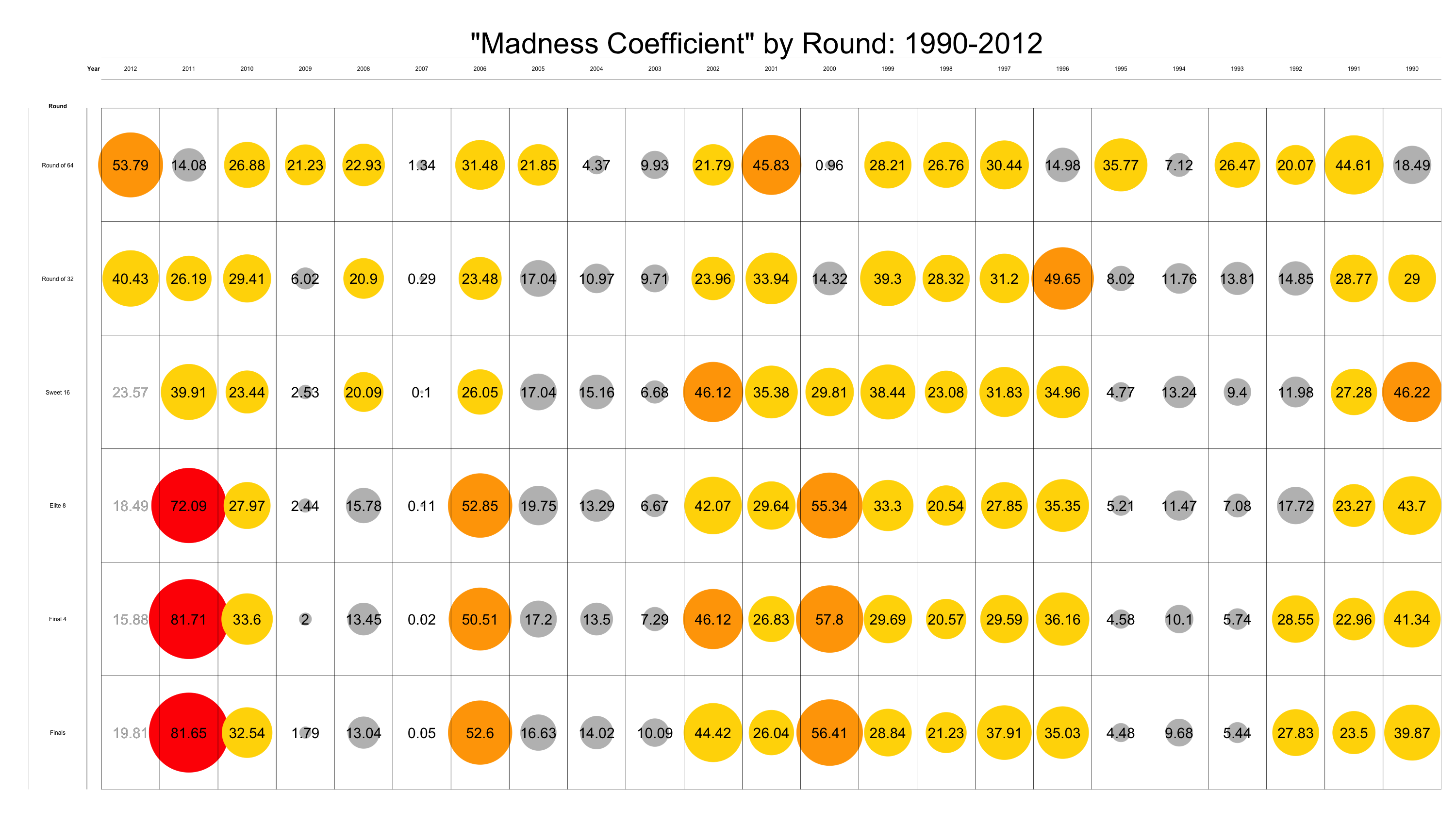
  • The first round of this NCAA tournament was the craziest dating back to 1990, and through two round (I don’t acknowledge the First Four as a round) this is the second craziest tournament over the same time period behind only 1996.  1996 featured a 12 seed in the sweet sixteen as well as a 1 seed knocked out in the round of 32.  2012 might be crazy, but all four number 1 seeds are still around.

    Note: Projected madness is based on higher seeds winning all remaining games.

    Cheers.


  • An email from a friend of mine:

    …they have a new “sliding scale” thing for their polls.  One question was: “How many of the double digits seeds that won (on Thurs/Friday) will make the Sweet 16?”  On one end of the scale was “none” on the other “5 or more”.  Seems straightforward enough.  Their sliding scale had 10 total partitions, the middle 8 all unlabeled.  This is why people don’t trust “statisticians”…..

    Here  (Scroll to the end of the article) is a link to an example of one of these “polls”.

    Cheers.

  • Kevin Cooksey's avatarLone Star Stats

    While watching the ending to the Texas/Cincinnati NCAA tournament game, it felt like deja vu. Because it was. In other big games this season, Texas’ deficit followed a similar course.

    This is game-flow data (moving left to right) compared to the advantage/deficit in points at a particular time during the game.

    Texas' NCAA Game vs. Cincinnati Compared to Other Notable Regular Season Games

    View original post

  • Alright.  It’s noon on Thursday.  You’ve still got 40 minutes until the games start.  Here are some of my final thoughts before the tournament starts.

    Generally, I think the tournament committee did a great job seeding these teams this year.  Unfortunately, that also means that we’re probably not going to see anything too crazy like a 8 vs 11 in the Final Four.  Of course, I’m always wrong about these things.

    The bubble

    Best 4 teams to not make the tournament

    Oral Roberts: Beat Xavier by 22 points

    Northwestern: Still never made an NCAA tournament, which is, honestly, quite impressive in its own right.

    Mississippi State: Top 15 in the AP poll on Jan 2, and they miss the NCAA tournament.  Season ended Tuesday with a loss to UMass in the first round of the NIT.

    Seton Hall: 8-10 in conference is only good enough if you are the defending national champs.

    Bottom 4 At-large bids

    Iona: Drexel got screwed

    Xavier: They are either a top ten team or outside the top 50

    South Florida: 2-9 vs the top 50.  Not good. (But better than Cal, apparently.)

    West Virginia: 9-9 in the Big East is not impressive.  (Although UConn was 9-9 last year and we know what happened there.) 4-8 against the top 50 this year.

    The seeds

    Best of each seed

    Best 1 seed: Kentucky

    Best 2 seed: Ohio State

    Best 3 seed: Marquette

    Best 4 seed: Indiana

    Best 5 seed: Wichita State

    Best 6 seed: Murray State

    Best 7 seed: St. Mary’s

    Best 8 seed: Creighton

    Best 9 seed: Alabama

    Best 10 seed: Purdue

    Best 11 seed: Colorado State

    Best 12 seed: VCU

    Best 13 seed: Ohio

    Best 14 seed: BYU

    Best 15 seed: Lehigh

    Worst of each seed

    Worst 1 seed: North Carolina

    Worst 2 seed: Kansas

    Worst 3 seed: Florida State

    Worst 4 seed: Michigan

    Worst 5 seed: Temple

    Worst 6 seed: UNLV

    Worst 7 seed: Notre Dame

    Worst 8 seed: Kansas State

    Worst 9 seed: UConn

    Worst 10 seed: Xavier

    Worst 11 seed: Colorado

    Worst 12 seed: Long Beach State

    Worst 13 seed: New Mexico State

    Worst 14 seed: St. Bonaventure

    Worst 15 seed: Loyola Maryland

    Best first round games

    UConn (9) vs Iowa State (8)

    Notre Dame (7) vs Xavier (10)

    Memphis (8) vs St. Louis (9)

    Florida (7) vs Virginia (10)

    Southern Miss (9) vs Kansas State (8)

    Temple (5) vs South Florida (12)

    St. Mary’s (7) vs Purdue (10)

    Best Projected Second Round Games

    Indiana (4) vs Wichita State (5): Everyone loves a mid-major team

    Florida State (3) vs Cincinnati (6): ACC Tournament Champ vs Big East Tournament Runner-up

    Louisville (4) vs New Mexico (5): Big East Tournament Champion vs Mountain West Tournament Champion.  No one seems to be talking about either of these teams.  Louisvlle just won 4 games in a row (Seton Hall, Marquette (3), Notre Dame (7), and Cincinnati (6), the last three on the road) to win the Big East tournament.  New Mexico just won three in a row (Air Force, UNLV (6), and San Diego State (6), the last two on the road) to win the Mountain West tournament.

    Most likely lower seed wins by seed

    9 seed: Southern Miss over Kansas State

    10 seed: Virginia over Florida

    11 seed: Texas over Cincinnati

    12 seed: Harvard over Vanderbilt

    13 seed: Ohio over Michigan

    14 seed: BYU overt Marquette

    15 seed: Detroit over Kansas

    16 seed: Vermont over North Carolina

    The 14 seeds

    I think we’re gonna see AT LEAST one 14 seed win a game in the first round this year.  A lot of people are really excited about Belmont (Sagarin has them ranked 33!), but I think BYU is the most exciting 14 seed.  South Dakota State and Saint Bonaventure are no joke either.  Sagarin has Belmont ranked ahead of Cincinnati (6), Temple (5), St. Mary’s (7), UConn (9).  In the same ratings, Belmont AND BYU are ranked ahead of West Virginia (10), Harvard (12), Notre Dame (7), Murray State (6), NC State (11), San Diego State (6), VCU (12), Xavier (10), Iona (14), Southern Miss (9), and South Florida (12).  Sagarin would have Belmont at 9 and BYU at 10; I would put BYU at 11 and Belmont at 13.

    My Final Four picks

    Kentucky (1), Ohio State (2), Michigan State (1), North Carolina (1).  I know these are boring picks, but that’s the way the brackets line up.  Sorry.

    I have Kentucky playing Ohio State in the finals with Kentucky ultimately winning the tournament.  Following the tournament the championship will then have to be vacated because Calipari is the coach and the only thing he loves more than winning is vacating Final Fours.

    Good luck to all the teams.

    Cheers.

  • Nan Laird is speaking at Smith College today at 5pm.  You should probably go to this.

    Finding Genetic Markers for Disease: Some Challenges and Opportunities for Biostatisticians, Thursday, March 15, 5 p.m., McConnell B15

    Nan Laird, Professor of Public Health and Biostatistics, Harvard School of Public Health. In the relatively short time span of less than 10 years, association analysis has become the primary study design for finding genes underlying complex disorders. Genome Wide Association Studies have discovered hundreds of new genetic markers which predict disease. Early successes with association analysis led to great excitement about the promise of GWAS for understanding the genetic basis of complex disease. Although the number of GWAS studies has proliferated rapidly, replications are often disappointing and Meta-Analysis has become an essential part of the process of gene discovery. This talk will review some features of GWAS that offer challenges and opportunities for Biostatisticians.

    Cheers.