Category Archives: Uncategorized
NCAA Football Picks – Week 2
September 6, 2013
Wake Forest at Boston College
Prediction: Boston College 22-16
September 7, 2013
UAB at LSU
Prediction: LSU 32-13
Alcorn State at Mississippi State
Prediction: Mississippi State 39-6
Arizona at UNLV
Prediction: Arizona 38-21
Arkansas State at Auburn
Prediction: Arkansas State 24-19
Army at Ball State
Prediction: Ball State 31-28
Austin Peay at Vanderbilt
Prediction: Vanderbilt 32-7
Bowling Green at Kent State
Prediction: Kent State 19-18
Buffalo at Baylor
Prediction: Baylor 40-24
Cal Poly at Fresno State
Prediction: Fresno State 31-20
UC-Davis at Nevada
Prediction: Nevada 44-17
Central Arkansas at Colorado
Prediction: Central Arkansas 27-24
Central Florida at Florida International
Prediction: Central Florida 25-14
Chattanooga at Georgia State
Prediction: Georgia State 23-20
Cincinnati at Illinois
Prediction: Cincinnati 24-13
Colorado State at Tulsa
Prediction: Tulsa 31-16
Duke at Memphis
Prediction: Duke 33-23
Eastern Kentucky at Louisville
Prediction: Louisville 33-12
Eastern Michigan at Penn State
Prediction: Penn State 35-10
Florida Atlantic at East Carolina
Prediction: East Carolina 26-22
Gardner-Webb at Marshall
Prediction: Marshall 38-20
Grambling State at Louisiana-Monroe
Prediction: Louisiana-Monroe 35-13
Hawaii at Oregon State
Prediction: Oregon State 31-12
Houston at Temple
Prediction: Temple 28-24
Idaho at Wyoming
Prediction: Wyoming 33-18
Indiana State at Purdue
Prediction: Purdue 23-13
James Madison at Akron
Prediction: James Madison 27-26
Lamar at Louisiana Tech
Prediction: Louisiana Tech 43-14
Louisiana-Lafayette at Kansas State
Prediction: Kansas State 28-20
Maine at Massachusetts
Prediction: Maine 22-21
Middle Tennessee State at North Carolina
Prediction: North Carolina 34-17
Minnesota at New Mexico State
Prediction: Minnesota 26-14
Missouri State at Iowa
Prediction: Iowa 28-12
Navy at Indiana
Prediction: Navy 31-27
New Hampshire at Central Michigan
Prediction: Central Michigan 27-20
New Mexico at Texas-El Paso
Prediction: New Mexico 26-23
Nicholls State at Western Michigan
Prediction: Western Michigan 30-16
Norfolk State at Rutgers
Prediction: Rutgers 27-9
North Texas at Ohio
Prediction: Ohio 28-20
Notre Dame at Michigan
Prediction: Notre Dame 22-14
Oklahoma State at UTSA
Prediction: Oklahoma State 37-17
Old Dominion at Maryland
Prediction: Old Dominion 20-18
Oregon at Virginia
Prediction: Oregon 36-16
Portland State at California
Prediction: California 36-14
Richmond at North Carolina State
Prediction: North Carolina State 28-14
Sacramento State at Arizona State
Prediction: Arizona State 34-14
Sam Houston State at Texas A&M
Prediction: Texas A&M 42-16
Samford at Arkansas
Prediction: Arkansas 31-13
San Diego State at Ohio State
Prediction: Ohio State 27-17
San Jose State at Stanford
Prediction: Stanford 23-16
Savannah State at Troy
Prediction: Troy 39-13
South Alabama at Tulane
Prediction: South Alabama 26-20
South Carolina at Georgia
Prediction: Georgia 20-17
South Carolina State at Clemson
Prediction: Clemson 45-7
South Dakota at Kansas
Prediction: Kansas 27-20
South Florida at Michigan State
Prediction: Michigan State 17-13
Southeast Missouri at Mississippi
Prediction: Mississippi 40-12
Southeastern Louisiana at TCU
Prediction: TCU 37-6
Southern Mississippi at Nebraska
Prediction: Nebraska 34-13
Stephen F. Austin at Texas Tech
Prediction: Texas Tech 41-21
Syracuse at Northwestern
Prediction: Northwestern 26-23
Tennessee Tech at Wisconsin
Prediction: Wisconsin 35-7
Tennessee-Martin at Boise State
Prediction: Boise State 34-12
Texas at BYU
Prediction: BYU 19-18
Toledo at Missouri
Prediction: Missouri 28-21
Utah State at Air Force
Prediction: Utah 27-20
Washington State at USC
Prediction: USC 31-14
Weber State at Utah
Prediction: Utah 30-14
West Virginia at Oklahoma
Prediction: Oklahoma 31-24
Western Carolina at Virginia Tech
Prediction: Virginia Tech 28-9
Western Kentucky at Tennessee
Prediction: Tennessee 30-23
Top 25 MLB Hitters – August 30, 2013
Updated August 30, 2013 at 12:34 am.
|


R package ‘nricens’ versions 1.1 vs 1.2
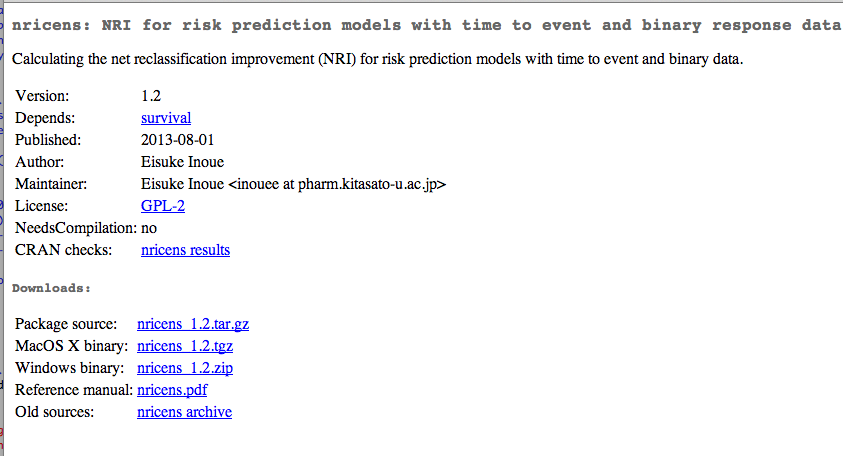
I’m trying to calculate a net reclassification index (NRI) using the ‘nricens’ package. I downloaded it from CRAN and tried to start using it. However, I couldn’t quite get it to work and I kept getting strange errors. So I went the documentation, and this just made me more confused because it seemed that the documentation didn’t match the functions. After some time (too long probably), I realized that the version in the CRAN repository (1.1) was not the same as the one for the documentation I was reading. So, I guess I am confused why there is documentation on the cran website for version 1.2, yet version 1.1 is the version in the repository.

Cheers.
An empirical look at PEDs in baseball
When the Biogenesis news hit during the offseason, anyone who follows sports should have been able to see what was coming. Essentially, PEDs in baseball elicit two responses – the moralizing type wherein the players involved are evil and the is-nothing-sacred type wherein heads shake at how sacred baseball numbers have been rendered meaningless. We get them all the time, but most often the first type tends to crop up whenever a ballplayer gets caught and suspended, while the second usually descend upon us along with Santa, every December when Hall of Fame ballots are cast.
This essay started as a joke-filled response to a specific article responding to Ryan Braun’s suspension. I think it mutated somewhere along the way into something more than a critique of what I thought was just a poorly considered opinion with hackneyed hyperbole, to the point I dropped all references to that article (except that previous sentence, natch.) What I hope it has become is a examination of what we know about PEDs and how people think about PEDs in baseball. Before getting into that, I want to be as clear as I possibly can be: I am extremely anti-cheating. Commissioner Bowie Kuhn instituted the first MLB Drug Policy, which prohibited the use of prescription drugs when not prescribed by a physician for a legitimate medical purpose. In 1991, a year after Congress decided to list steroids as a controlled substance (contrary to the recommendation of the DEA, FDA, NIDA and AMA, btw), Commissioner Fay Vincent issued a league-wide memo emphasizing that steroids were prohibited by the MLB Drug Policy. In 2005, MLB and the MLBPA implemented PED testing and suspensions, and modified it later that same year (the full list of banned substances under the MLB drug policy can be found here). It could not be made clearer than it is now: PEDs are prohibited and constitute cheating. Some folks think the penalties can be made even stiffer and some question whether testing is at all effective, but the rules and the penalties are in place and are being enforced*.
* As an aside, I’m going to indulge myself in something that bothers me. Players, sportswriters (that article is, in my opinion, an embarrassment) and Bud Selig all advocate harsher penalties for PED users. Which, as I said, is fine. But the NFL routinely docks players four games and that’s that (four games, being a quarter of the NFL season). But, while baseball’s stars end up almost-pariahs (unless you’re Andy Pettitte or David Ortiz), football players serve their suspensions and move on. Meanwhile, Mark McGwire had to apologize just to coach for the Cardinals (and that still wasn’t good enough for some folks). I know I’m not the only person who doesn’t understand the football/baseball double standard, but it bothers me that Ryan Braun and Alex Rodriguez getting caught for PEDs are national crises, but eight Washington football players getting PED suspensions since 2011 is no big whoop for football.
Cheating is cheating; if there is a rule, you break it at your risk of punishment. Pete Rose is banned from baseball because he broke the cardinal rule in all of baseball: never gamble on games. He was caught, he was banned. PED users are breaking the rules, and they are tested. Those who are caught are punished. It’s a system that is working, because we have players getting caught (the issue with baseball from 1991, when Vincent sent his memo, until 2005 when the Joint Drug Agreement was enacted, was that steroid use, though banned, wasn’t tested for or punished.) My issue isn’t with that. I think it’s incredibly important we all acknowledge that cheating is a part of competition (yes, I’ll even cite Aussie rules writers), and in American sports with money, prestige, fame, endorsements and whatever else on the line, the incentive to cheat is going to be that much stronger. Heck, cheating was a part of the ancient Olympics, long before billion dollar TV contracts and sneaker endorsements. But it doesn’t inevitably mean it should be condoned (an obvious statement that I stress only to make my own point below). I don’t really have any issue with people who want to argue stiffer penalties or even how the Hall of Fame should treat cheaters. But there is still a fundamental issue that people ignore entirely.
_____________
To be clear where I’m coming from, I have to point out that, by profession, I am trained in reading and interpreting scientific studies. It’s a critical skill if you want to be able to sift through things that purport to be science, and it has made me something of an empirical skepticist. Empirical skepticism leads me to not buy into things (or at least try very hard not to) until credible evidence exists to support them. It’s an approach to making sense of every day life and big picture things. It’s the reason why, for example, when I read an article like this one on CNN talking about how men with higher omega-3 fatty acid intake have a higher risk for prostate cancer, I don’t immediately fear a salmon dinner. I try to look into what exactly they’re reporting on and it turns out, it’s this study, which didn’t actually examine the connection between taking omega-3 supplements or eating lots of fish. The study actually compares the level of free fatty acids in the blood between men who developed prostate cancer against men who didn’t, and they found that those men in the study who did develop prostate cancer tended to have higher circulating fatty acid levels. It’s an interesting study, but it does not conclude that men should, as the CNN article is headlined, “Hold the salmon: omega-3 fatty acids linked to higher risk of cancer.” There appears to be an association with blood levels of certain fatty acids and prostate cancer. We don’t know what the actual risks are, and that also means we don’t know if the risk of prostate cancer outweighs the benefits of the healthy types of fatty acids. We can’t know that until we have more data. Correlation doesn’t mean causation (Nate Silver’s third point from his talk at JSM). This study just provides a base that further research can explore and illuminate.
You may ask, “what the heck does prostate cancer and fish oil have to do with baseball and PEDs?” I share the bit about the fish because, to set up what my issue with the whole PED argument in baseball, you need to understand how science looks at these issues. I love baseball and have for my entire life. The emotion surrounding the idea of breaking the rules of baseball is something I feel deeply about, so I understand where a lot of the moralizing comes from just as I get the emotion behind an interpretation of the fatty acid study of, “we need to be careful of fish oil because it gives us cancer!” Sometimes, though, in order to actually understand issues like this, the emotion needs to be separated from how we actually consider the issue. Likewise, with PEDs the emotion of how we feel about players cheating must be overcome if we are to actually take a look about the larger issue of the impact on PEDs on the sport of baseball.
So what’s my big issue? Well, it stems from the fact that we don’t have an answer to the most basic question involved: how much do PEDs help someone play baseball? I know what the consensus opinion is. Everybody seems to think they know, because, deep down, they have to help. What most people don’t realize is that there’s actually a broad gap between what you think you know and what you actually know (if you want to learn to bridge that gap, may I recommend starting here and here. That’s purely an aside.)
_____________
Careful scientific investigation has certainly revealed what performance enhancing drugs do under controlled circumstances. We basically know what PEDs do only in limited context. Most real science examines the potential uses from a therapeutic standpoint. It’s easy to find out what anabolic steroids do for cachexia patients or in hypogonadal men, but reports of what happens to athletes largely come from self-reporting via surveys. That sort of information is useful, but it still is limited because of a variety of biases you’d expect from self-reported users who volunteer their experiences. The gold standard of scientific inquiry are randomized controlled studies- taking two similar groups of subjects, in adequate numbers, with maximally controlled variables and measuring differences in outcomes. We have very few such examples, to the tune of practically none.
This is not to say, we don’t know what PEDs do in sports. EPO, or erythropetin, is a popular PED in endurance sports, such as cycling. We know exactly what EPO does, because it is well studied. EPO (the drug) is synthetic version of the EPO (the hormone) the body naturally produces to upregulate red blood cell (RBC) production. RBCs carry oxygen to body tissues, and natural EPO levels are increased when athletes train at altitude. The effects of EPO on endurance athletes is supported by scientific evidence- EPO upregulates RBC production, increasing total oxygen carrying capacity, decreasing muscle hypoxyia (lack of oxygen) by increasing oxygen availability for working muscles.
What we know about anabolic steroids and HGH in sports is murkier. As I said, the effects on individuals suffering from particular diseases are well documented. Anabolic steroids are essentially testosterone precursors. Anabolism literally means “building up”, and anabolic steroids are prescribed for individuals that cannot produce testosterone (e.g., cancer patients, trauma victims), individuals suffering from wasting syndromes (e.g., HIV/AIDS, chronic obstructive pulmonary disease), among other, less well studied treatments. HGH, likewise, has a number of therapeutic uses, some understood well, some more experimental, but essentially it has some anabolic properties and some lipolytic (fat reducing) effects.
But what about ballplayers? The connection between EPO and endurance athletes is linear; distance runners and cyclists uses their muscles for long periods of time, so increased available oxygen will let the muscles work more efficiently. The link between what anabolic steroids and HGH will do for a ballplayer is not quite so clear cut. Anabolic steroids do indeed lead to an increase in lean muscle mass and body strength, though the benefits to athletes taking HGH is much more questionable. An article in the May 2008 Annals of Internal Medicine,“ titled “Systematic review: the effects of growth hormone on athletic performance” concluded:
Claims that growth hormone enhances physical performance are not supported by the scientific literature. Although the limited available evidence suggests that growth hormone increases lean body mass, it may not improve strength; in addition, it may worsen exercise capacity and increase adverse events. More research is needed to conclusively determine the effects of growth hormone on athletic performance.
Clouding the picture further is the complexity of the mechanics of hitting or pitching. A baseball swing, for example, is reasonably well studied. Bat speed, pitch recognition, hip rotation, lower leg movement, and reaction time are all key components. The only component of a swing that studies indicate improves from increased muscle strength is bat swing velocity. Beyond that we don’t actually have a clear idea. Furthermore, we lack clear evidence of what specific PEDs would do in improving the components of the actual swing. If there was a more obvious connection between strength and hitting, that’d be something; guys like Ozzie Canseco, Wily Mo Pena and Gabe Kapler would hit like Ruth. Now, in the interest of empiricism, I’m willing to accept that these guys could be exceptions rather than rule. My overall point is that we do not know if hitters are helped when they look like pro-wrestlers*. But, unfortunately, data simply doesn’t exist. We assume that it’s steroids that helped Mark McGwire’s Bunyanesque arms hit all those taters (and some try to figure out how many he would have hit if he wasn’t fueled by steroids), and we lament that Ken Griffey Jr. is “The Last Clean Superstar”. People just don’t seem to realize that those assumptions are based on one humongous chunk of speculation.
* Macho Man Randy Savage, a WWF wrestler in the 80s and 90s, was signed by the St. Louis Cardinals in 1971 and played three years in the minors until he hurt his throwing shoulder in a catcher collision. I wonder what he would done at DH at his most pumped up.
_____________
A strawman that I just conjured up is going to counter my argument- “If PEDs didn’t help ballplayers hit or pitch, why would anyone take them?” And that would be a very reasonable question to ask, since there looks to be one heck of a number of players caught for using PEDs. But go to GNC and look at the number of tubs you can buy for $40 or more. All of these supplements, at best, have questionable evidence to support them, and at worst, none. As a comprehensive review from the University of Texas puts it “Many weight lifters [sic] swear by their own combination of magical supplements that have no scientific basis whatsoever.” The evidence we have for their efficacy is scant, and yet Americans spent $2.7 billion in 2008 on exercise supplements, some of which are made in people’s garages.
(As an interesting tangent, regarding anecdotal evidence and these sorts of things, a study published in the September 2004 issue of the journal Addiction recruited 80 weightlifters, 43 of whom were admitted users of anabolic steroids. The investigators surveyed the participants about their attitudes towards physicians knowledge regarding a variety of health related topics, including anabolic steroids. Both users and non-users had similarly high ratings of physicians’ knowledge about almost every health topic except steroids. Users rated physicians no more knowledgeable than friends, the Internet or the folks who gave them their steroids, and 40% trusted their dealer’s information at least as much as their physicians’.)
The problem is, with both supplements and PEDs, we have extremely limited scientific data to support the claims about what they do. What we have in spades are anecdotes and locker room talk about what you should take to blast your delts or to hit some dingers. The fact that it’s anecdotal and not based on rational scientific study seems to be lost on not just the users, but even some very smart observers (if you read that, keep in mind the physicist is suggesting that Manny Ramirez should have been hitting about 60-80 home runs or maybe he was doing steroids wrong— Manny being Manny, I guess.) For supplements, a big reason we don’t have the data because of the arcane way the FDA regulates (to wit, does not regulate at all) and the money the industry makes; randomized controlled trials would accomplish nothing positive for the manufacturers. For PEDs, I suspect the biggest issue is stigma. Imagine that you’re an exercise physiologist at a university and you wanted to study what an anabolic steroid does to a healthy, college-aged athlete. You need someone to actually fund your study of a taboo topic plus an adequate sample of college-aged athletes that are willing to volunteer to take banned substances in the name of science. The contribution to the collective knowledge would be great, but the obstacles seem even greater.
If you’re still into anecdotal evidence, I can offer some via the king of the juicers himself, Jose Canseco. For a number of years, Canseco was the world’s biggest steroid advocate. In his book Juiced, Canseco said, “I would never have been a Major League-caliber player without steroids.” But, in 2010, his song changed as he attempted to repair his image. This is the most interesting thing, I think, Canseco has to say:
Let me give you a perfect example. I have an identical twin brother, Ozzie. He is the closest thing to me genetically. And in my prime I was a super athlete. I was the fastest guy in the game. I was 240 pounds and I could hit a baseball 600 feet. The best arm in the game. My twin brother used the same chemicals, same workouts, the same nutrition. Why didn’t he make it in the big leagues?
That is the perfect example that we are giving steroids way too much credit. If steroids are that great it would have made him a superstar.
This suffers from both small sample size issues as well as being purely anecdotal. Ozzie was also drafted as a pitcher, so maybe he cared more about pitching than power hitting (though he was converted to a hitter in the minors.) I don’t know for sure that Jose is being truthful, and Ozzie and he did use the same drugs and workout the same way (and it’s believable based on his baseball card I linked to above.) But we apparently have identical twin brothers, on presumably identical regimens for training and both trying to be major league ballplayers; one ends up with a 17 year career, 462 HRs and Baseball Reference most similar players are all good-to-great hitters, while the other played in just 24 games and was a total washout. How do we account for the stark difference between the Canseco brothers? The differences, as I said, are purely anecdotal, but without empirical studies, that’s at least interesting and based on something that happened.
_____________
In Nassim Nicholas Taleb’s book The Black Swan, he describes what he calls “the narrative fallacy”: the tendency for people to construct a story around facts regardless of whether the story itself is true. It’s also known as the “Texas Sharpshooter Fallacy,” based on an old joke about a Texan who shoots at a barn and afterward paints targets around the clusters of shots (I discussed this before when talking about box-office receipts.) We know that anabolic steroids help build muscle, and there is evidence that exercise endurance and healing may improve, and we determined that homers are flying because of them. The steroid era, we decided, coincided with the offensive explosion of the 90s, so it’s the cause of it. The consensus story is a compelling one, but there are many who still believe stories regarding vaccines and autism or dental amalgam and multiple sclerosis, despite refutation or lack of evidence. We collectively decided that winstrol and deca-durabolin turned Barry Bonds from extraordinarily great baseball player to a homer-hitting monster, while we ignore Tom House saying that he and teammates had been using steroids in the late 60s and 70s, because, in part, opponents were using steroids.
It’s easy to construct a narrative around the types of players who have been caught. Looking down the list of the names of suspended players, the majority are fringe guys with some older players mixed in. There are very few solidly-established players in their prime. A story about most PED users are just players trying to stay on the roster. But while these facts may support that particular story, and some folks buy into this, we don’t really have the information to make that call either.
I am not suggesting that Barry Bonds and Roger Clemens would have performed just as remarkably into their 40s without their (alleged) chemical help. Likewise, maybe Ryan Braun wouldn’t have been the 2011 NL MVP or Ken Caminiti the 1996 NL MVP. Maybe they’d have been bad, or mediocre, but maybe there’d have been no difference at all. The fact it is, we don’t actually know what PEDs do for baseball players. But because of what we assume about PEDs, we have a 2013 Hall of Fame induction for three long-deceased guys, players being made out to look like mustache-twirling villains, and so many remarkable feats accomplished on a field stirring a knee-jerk response of, “well, he must be on steroids.” And I think it’s entirely understandable to feel a bit jaded. But those emotions end up clouding everything from individual game broadcasts (Michael Kay and John Flaherty, in A-rod’s first game of 2013, all but called him selfish for not accepting his 211 game suspension) to the aforementioned Hall of Fame weekend to the sport in general (NFL gets the Super Bowl, MLB seems to have had a month-long funeral leading up the Biogenesis suspensions). And they, naturally, cloud the very basic that we have no real clue what PEDs do for a player?*
* As a return to my aside about the double standard between football and baseball, my favorite sports writer, Joe Posnanski (how can I not love a guy as loquacious as I am?) recently wrote about this topic, and pointed out a few of the same points I have (but in a much more professional and entertaining way), but also something that I hadn’t quite been able to articulate. Doubtlessly, Poz says, at least some of the NFL’s concussions and subconcussive injuries and ACL tears and whatever else were caused by players made stronger because of PEDs. And that is something we know PEDs do. Which makes that double standard all the more perplexing to me.
Now, there are still a lot of ethical issues with PED use in general. Fringe players or minor leaguers trying to hang on (regardless of whether or not they’re the majority of users) is still a problem. Regardless of whether or not PEDs do actually make for better ballplayers (which, remember, we don’t actually know), the perception that they do is still present. Similarly, the perception (or knowledge) that other players are taking PEDs , and the temptation will be there. In the end, PEDs don’t actually have to help a player hit homers; he just needs to think they might. That same perception is why the weight lifters buy those foul smelling powders for outrageous sums of money, irrespective of their actual impact.
In the end, I can’t help but feel that this is a problem that people will be content enough to ignore. While some people seem to have an evolving point of view, I suspect they, for now at least, will prove the exception. Which is a shame. If one accepts the basic premise- PEDs are cheating, baseball tests for PEDs and punishes those who are caught- PEDs can be tucked into the same parts of our brain that have already squared away (consciously or not) some of baseball’s other seedier issues: amphetamines, doctored balls, and creative groundskeeping. Cheating is part of the game; if you can make a cogent argument that there is a clear distinction between cheating by using amphetamines and soaking an infield for ground ball pitchers and cheating by using PEDs, I’d love to hear it (and I mean, it has to go beyond the appeal to emotion in the above-linked Willie Mays article.) The sport is not ruined. And if we can all accept a little bit of empirical skepticism, it might just be easier to accept that fact. Maybe baseball (and this is the only time I’ll ever say this) could finally be a little more like football— punish the cheaters, and move on.
Tim is an orthodontist by training and trade. He also writes, performs comedy, is a part time (generally unpaid) artist, and once did the art design for a iOS game (dontfrythefrog.com). You can read a earth shattering exposé he wrote about ALF Colorforms at www.saturdaymorningdeathgrip.com, where you can also listen to the podcast he co-hosts about 80s and 90s cartoons. You can visit him at tpxdmd.blogspot.com, follow him on twitter @tpxdmd, and listen to “Saturday Morning Deathrgip.” Also, if you want your teeth straightened, he can do that too.
Top 25 MLB Hitters – 8/9/2013
Updated August 9, 2013 at 12:34 am.
Yearly Production for a player is the approximate number of runs a team would score if the entire lineup consisted of the same player.
Total Production is weighted by the number of plate appearances.
|
Top 25 MLB Pitchers – 8/8/2013
Updated August 8, 2013 at 12:34am
Total Prevention is a measure of runs prevented weighted by the number of batters they have faced (Higher is better).
Yearly Expected ER is approximately the expected number of runs that a team would allow is that pitcher pitched every inning of every game for a team (Lower is better).
|
MLB Rankings – 8/8/2013
StatsInTheWild MLB rankings as of August 8, 2013 at 2pm. SOS=strength of schedule
| Team | Rank | Change | Record | ESPN | TeamRankings.com | SOS | Run Diff |
| Detroit | 1 | ↑2 | 67-45 | 6 | 1 | 13 | +144 |
| Boston | 2 | – | 70-46 | 1 | 2 | 9 | +109 |
| St. Louis | 3 | ↓2 | 66-47 | 5 | 8 | 25 | +144 |
| Tampa Bay | 4 | ↑3 | 66-47 | 4 | 3 | 7 | +62 |
| Atlanta | 5 | ↑5 | 70-45 | 3 | 4 | 30 | +121 |
| Pittsburgh | 6 | ↓2 | 69-44 | 2 | 5 | 21 | +59 |
| Baltimore | 7 | ↑1 | 63-51 | 10 | 7 | 4 | +31 |
| Oakland | 8 | ↓2 | 64-49 | 7 | 10 | 15 | +54 |
| Texas | 9 | – | 65-50 | 12 | 6 | 14 | +41 |
| Cincinnati | 10 | ↓5 | 63-51 | 11 | 11 | 18 | +68 |
| Cleveland | 11 | ↑2 | 62-52 | 9 | 9 | 11 | +42 |
| Kansas City | 12 | ↑4 | 58-53 | 13 | 13 | 8 | +22 |
| LA Dodgers | 13 | ↑12 | 63-50 | 8 | 12 | 29 | +23 |
| NY Yankees | 14 | ↓3 | 57-56 | 14 | 14 | 2 | -20 |
| Toronto | 15 | ↓3 | 53-61 | 19 | 15 | 1 | -26 |
| Arizona | 16 | ↓2 | 58-55 | 15 | 16 | 27 | +11 |
| LA Angels | 17 | ↑1 | 51-62 | 18 | 18 | 12 | -24 |
| Seattle | 18 | ↑8 | 53-61 | 21 | 17 | 10 | -58 |
| Minnesota | 19 | – | 49-62 | 26 | 19 | 6 | -64 |
| Washington | 20 | ↑1 | 54-60 | 16 | 20 | 24 | -39 |
| Chi Cubs | 21 | ↑1 |
50-63 | 25 | 22 | 17 | -27 |
| NY Mets | 22 | ↑6 | 51-60 | 23 | 21 | 28 | -31 |
| Colorado | 23 | ↓8 | 52-63 | 17 | 25 | 26 | -33 |
| SF | 24 | ↓7 | 50-63 | 24 | 27 | 19 | -62 |
| Philadelphia | 25 | ↑2 | 51-62 | 22 | 24 | 20 | -90 |
| San Diego | 26 | ↓6 | 52-62 | 20 | 23 | 23 | -62 |
| Milwaukee | 27 | ↓3 | 49-65 | 27 | 26 | 16 | -62 |
| Chi WSox | 28 | ↓5 | 43-69 | 29 | 28 | 5 | -78 |
| Miami | 29 | ↑1 | 43-69 | 28 | 29 | 22 | -88 |
| Houston | 30 | ↓1 | 37-76 | 30 | 30 | 3 | -167 |
Past Rankings:
 Stats in the Wild


