Some polite comments on Mac Engel’s article “Mathematics is not a friend of baseball”
Perhaps Mac Engel is a brilliant satirist or perhaps he is just trying to get people to pay attention to him.
As a statistician, I’m going to make an assumption (that’s what us stats guys do), and I’ll start by assuming that Engel is indeed sincere in his belief that “Mathematics is not a friend of baseball” in his article of the same title. Assuming this is true, it seems clear to me that he doesn’t really have any idea what he is talking about.
Engel’s article opens with some jokey, over-the-top claims about math in sports (number-crunching will ruin your kid’s dodgeball game!). But his overall point appears to be in earnest. In his second paragraph (if you can call anything in this a paragraph; it’s more collection of individual sentences) he says (emphasis added):
Scores of math whizzes, nerds and live-in-their-parent’s-basement geeks are threatening to turn Royals at Rangers into a Bobby Fisher vs. Boris Spassky chess match, minus the intellect.
This sentence demonstrates clearly that Engel does not understand the nature of statistics today and how they are applied to baseball.
First, the phrase “live-in-their-parent’s-basement geeks” is being used derogatorily here to indicate that statisticians are losers unable to function in society, and are thus relegated to their parents’ basements because of their personal and professional failures. This was my first indication that Engel has no idea what he’s talking about. These “live-in-their-parent’s-basement” geeks surely exist , but in today’s world these geeks more often come in a different variety: the employed-in-a-recession-six-figure-income kind. (There’s also the rock-star-stats-geek like Nate Silver, who is more important to the New York Times’ website traffic than most of its regular journalists.) While journalism jobs are rapidly disappearing, jobs based on data are expanding so rapidly that there are not enough people with the skills to fill these positions. Nearly all of the successful businesses in the world know the value of data (see: Book, Face) and you can argue that one of the big differences between Obama and Romney in the last election was how the two campaigns handled, managed, and took action based on data and analysis (Obama embraced it, Romney largely ignored it; how did that work out?). The point is, the best way to make decisions is when those decisions are based on data and appropriate analysis. Baseball is a game where many decisions must be made, and those decisions can best be made when they are aided by data.
Secondly, Engel seems to fail to grasp a major difference between chess and baseball: chess is deterministic; baseball is not. Every time a chess player moves Bg5, the bishop gets there with certainty, whereas in baseball, not every routine fly ball will get caught (and sometimes they bounce off your head and go over the fence). He correctly notes that this uncertainty is what makes baseball exciting. As he says: “Math is never wrong. Baseball very much is, which is why I love it.” I’m not sure exactly what he means by “math is never wrong,” but when he says “baseball very much is,” I assume he is implicitly referring to random event outcomes. And this is precisely why math, specifically statistics and probability, is useful in making decisions in baseball. Statistics and probability give us a principled way to quantify uncertainty about events that have occurred in the past and events that will happen in the future. Statistics can’t say what is going to happen on any given play with certainty (e.g., Miguel Cabrera will hit a home run in this at-bat), but it can help someone to make statements about how likely an event is to occur (e.g., Miguel Cabrera is more likely to hit a home run in an at-bat than Norichika Aoki). And just because we can’t say with certainty what will happen on any given trial doesn’t mean that it isn’t useful. There are entire companies that exist based on events that might only occur 1 in 1000 times (think click-throughs on an ad, or responses to fake Viagra emails).
So what numbers and maths are specifically ruining baseball in the opinion of Engel? Is it the often cited and complicated wins above replacement (WAR) statistic? Nope. Is it the opaque Ultimate Zone Rating (UZR)? No, not that either. The entire rest of the article is about how math has ruined the game and made us a “prisoner to all of these bleepin’ numbers,” and his example is: PITCH COUNTS!
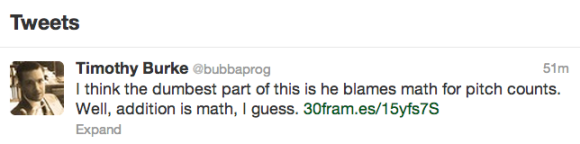
Pitch counts are an example of math in baseball in the same way that page numbers are an example of math in literature. If you think numbers and math are ruining baseball, which I disagree with thoroughly, I’m sure you can make a reasonable argument, but you need to be more persuasive than talking about pitch counts. There is a reason the Oakland A’s won all those regular season games with their tiny payroll, and it wasn’t simply luck. They were making better decisions that everyone else at the time because they were using data in a better way than their opponents, and it gave them an advantage in the long run.
So what I’m trying to say is that math and statistics aren’t ruining baseball. Now if you’ll excuse me I’ve got to go do the dishes. I can hear my mother yelling at me from upstairs.
Bill Barnwell is still blocking me on Twitter
I’m still blocked from following @BillBarnwell on Twitter. But what I don’t quite understand is what is the point of blocking anyone if your account is public? I’m blocked from following him, but I can still read all his tweets because his account is public. So, what do you gain by blocking someone? There must be some benefit to it? Is it just that I can’t direct message him? 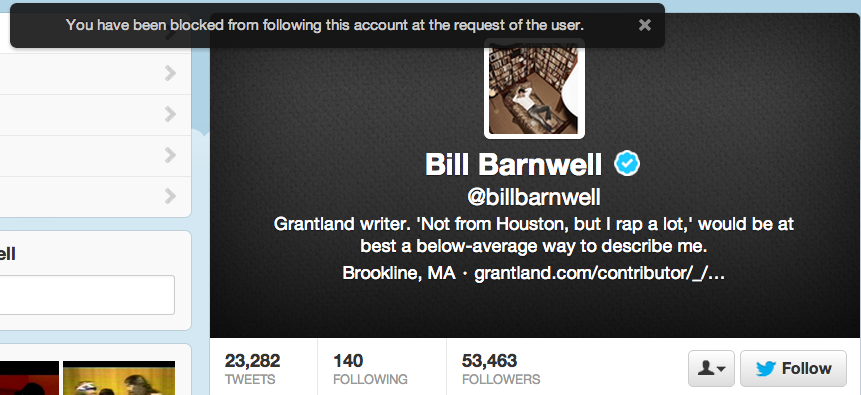
Cheers.
Map: Do You Live In IHOP America Or Waffle House America?
Deadspin answers the question of whether you live in IHOP America or Waffle House America.
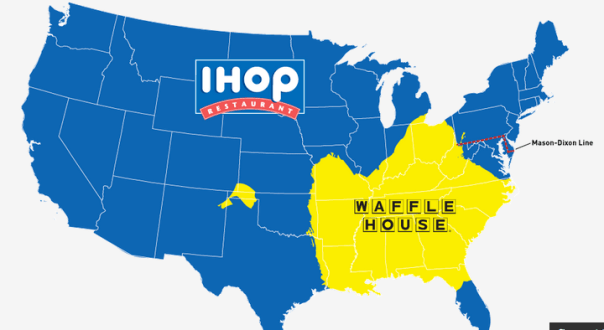


I also found it particularly interested that at the very end of the Deadspin article they say:
Waffle House does so much business in the South that the impact of hurricanes on Waffle House service is actually an informal measure of hurricane intensity.
Cheers.
Survivorship Bias

The Misconception: You should focus on the successful if you wish to become successful.
The Truth: When failure becomes invisible, the difference between failure and success may also become invisible.
In New York City, in an apartment along the Hudson River, above trees reaching out over sidewalks and dogs pulling at leashes and conversations cut short to avoid parking tickets, a group of professional thinkers once gathered and completed equations that would both snuff and spare several hundred thousand human lives.
People walking by the apartment at the time had no idea that four stories above them some of the most important work in applied mathematics was tilting the scales of a global conflict as secret agents of the United States armed forces, arithmetical soldiers, engaged in statistical combat. Nor could people today know as they open umbrellas and twist heels on cigarettes, that nearby, in an apartment overlooking Morningside…
View original post 6,331 more words


Dissertation Boot Camp: Val Style
I graduated from UConn in 2011, and I gave a talk there this morning. After my talk I met with some friends for lunch who are in the middle of their dissertations. As it starts to get nice outside in Storrs, many of them are having trouble writing their dissertations. As such, my former office mate (and future “doctor”) has been running “Dissertation Boot Camp”. I’m told that this wasn’t her idea, but she has added her own touch to it. Basically, student pay her $80 dollars and if they don’t commit too many infractions over the period of boot camp, they get all or part of their money back, hopefully with a completed dissertation. Below are the rules and consequences that Val has set forth for boot camp. If you want to use Val’s template for your own dissertation bootcamp, you get get it here.
The rules:
- Show up on time. You must sign in/out when you enter/leave the lab.
- Keep talking to a minimum. If asked to stop talking, you must do so immediately.
- Internet usage is for dissertation related business only
- You are allowed one hour off during bootcamp hours to be taken at whatever time (or times) you chose.
- Apply for a minimum of 3 jobs per week outside of dissertation bootcamp hours. Print confirmation and submit at end of week.
The consequences:
- First infraction: Verbal warning
- Second infraction: Buy Val coffee that morning
- Third infraction: Buy Val coffee for a week
- Fourth infraction: Val will take $10 from your dissertation fee
- Fifth infraction: Val will take $20 from your dissertation fee
- Sixth infraction: Val will take $50 from your dissertation fee
- Seventh infraction: Val will rate you on http://www.ratemyprofessor.com. It will be a one star rating.
- Eighth infraction: Val will send an anonymous email to your advisor. It will say “<Insert your name here> is not motivated or smart enough to earn a PhD”
- Ninth infraction: Val will send an anonymous email to your advisor. It will say, “<Insert your name here> thinks your research is not at all innovative or useful.”
All Killer Tornadoes Since 1950
I feel like tornadoes have been everyone recently. I was driving home yesterday and I was listening to an NPR piece about the recent tornado in Oklahoma, and the broadcast was interrupted by a tornado warning for western MA/Northern CT/Eastern NY. Even though this warning happened to be no where near me, I’m way more terrified of tornadoes than I ever used to be as I figured they couldn’t happen in Massachusetts. But my false sense of security was destroyed almost 2 years ago when a tornado missed my house by about a quarter mile on the first official day of my post-doc appointment. I certainly won’t forget my first day of work.
Anyway, here is a nice visualization of all tornadoes that have killed someone since 1950. Click on the image to get to the interactive version of the map. Stay safe.
 Cheers.
Fluoride and Portland
Here is an excerpt from the article “What’s the matter with Portland?” (Read the full article here) about the city’s refusal to fluoridate their water supply.
“What is alarming to me … is that [fluoride includes] known contaminants … I don’t think it makes any sense to add more contaminants to our kids’ water.”
She [Kellie Barnes, spokeswoman for Clean Water Portland] is referring to a National Science Foundation study from June 2012 that showed that 43 percent of “fluoride products” contain trace elements of arsenic, 2 percent contain similar proportions of lead, and 2 percent copper. However, what Clean Water Portland does not say is that the report finds that the amounts of heavy metals found in these samples are so minuscule as to be completely innocuous; none come remotely close to the EPA’s Maximum Contaminant Levels. Similar flaws can be found with Clean Water Portland’s analysis of many of the studies that supposedly support their cause. The centerpiece of their argument is a Harvard review of studies which concludes that naturally occurring fluoridation may lower child IQ—at levels more than 10 times higher than any ever recommended in the United States. The research looks pretty shaky anyway, considering that most of the studies didn’t control for parental education and household income, among other factors. CWP claims that a 2006 studyfrom the National Academy of Sciences links fluoride in drinking water “to a broad spectrum of human health ailments from neurological damage and thyroid disorders … and increased risks of bone cancer.” But, again, the study looks at far higher concentrations of fluoride than have ever been recommended in the United States. The chairman of the commission responsible for the study, John Doull, even wrote (regarding a policy battle over fluoridation in Kansas City): “I do not believe there is any valid scientific reason for fearing adverse health conditions from the consumption of water fluoridated at the optimal level.”
I’m highlighting this portion because it seems to be a tactic used my many anti-fluoridaters/anti-vacciners (the anties). They point to studies and only mention the parts that boost their argument. Here they talk about “fluoride products” containing copper, lead, and arsenic. Terrifying right? But they fail to mention that the quantities are so low that they are essentially harmless. Thankfully good scientists weigh both the risks AND the benefits against each other when making decisions, and don’t just focus on one side or the other.
And one other part of the anti-fluoridation argument that baffles me is that many communities also chlorinate their water, but no one seems to have as problem with that? Why is that?
Cheers.
Greatest comebacks in recent Boston sports history
I meant to send this out earlier in the week, but I’m just getting to it now. Great stuff from StatsByLopez. Make sure to check out the FanGraphs graph of the 2004 ALCS series. Really neat display of that data.

The greatest comebacks in post-2000 Boston sports history, ranked by a combination of estimated statistical improbability & game importance (postseason only).
1. Red Sox 2004 Series vs. NY Yankees: Win Probability, 0.0175 (1 in 60).
This win probabilities accounts for Mariano Rivera as the Yankees closer (0.14 chance of the Sox winning Game 4), and uses an equal chance of each team winning the final 3 games (1 in 8 for the Sox winning all 3). I thought this graph was pretty unique, as it looks at the series probabilities across all seven games. The opponent and situation (ALCS) increase the importance of this comeback, helping to make it the greatest in recent Boston sports history.
2. Bruins 2013 Rd 1 Game 7 vs. Toronto: Win Probability: 0.02 (down by 3, 10 minutes left) and 0.007 (down by 2, 1.4 minute left).
I don’t think I realized how unlikely this…
View original post 833 more words
Today in baseball history
1902 – Two deaf-mutes face each other for the first time when Dummy Hoy leads off for the Reds against Dummy Taylor of the Giants. The Reds win, 5 – 3, with a 5-run rally in the 9th. Hoy goes 2 for 4.
Wow.
 Stats in the Wild
