Category Archives: Uncategorized
NHL shootouts aren’t random. So let’s stop calling them that.

The National Hockey League has once again made headlines for tweaking its standards of playoff qualification, this time deciding it would look into into modifying the league’s shootout system. In the current structure, a shootout concludes any 5-minute overtime session ending without a goal, with the winning team earning an extra point towards season standings
One of the major factors in the NHL’s thinking, as it turns out, is that shootouts are too random. Just today, a Toronto columnist called the shootout a coin flip.
Statisticians, including ones I have a lot of respect for, have frequently enforced this idea. In an old post on SB Nation, St. Lawrence associate professor Michael Schuckers walks through several analyses to show that the distribution of…
View original post 1,128 more words
Conference Spam
I recently received the following email advertising the “outstanding event Obesity-2014”:
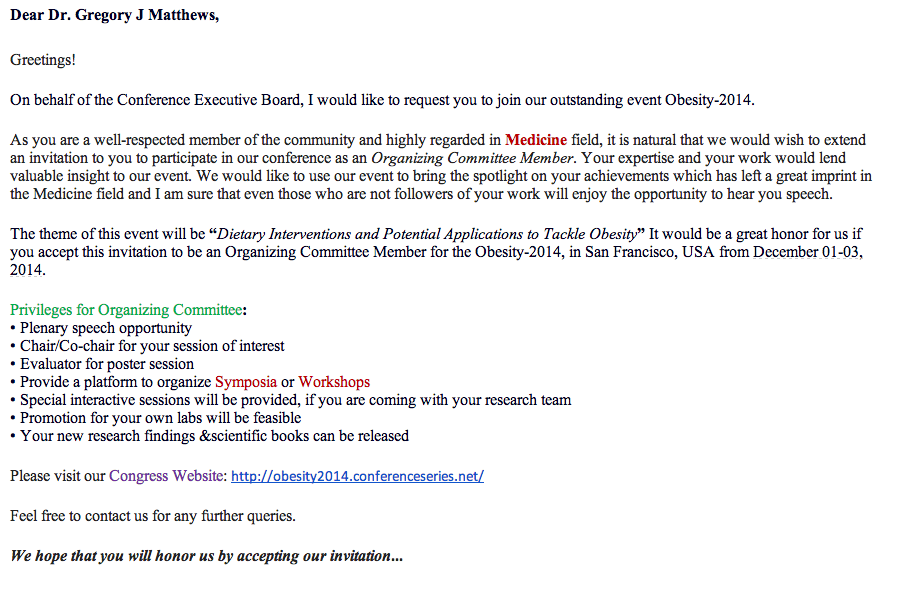
It is quite an honor to be so “highly regarded in Medicine field” and be invited to such a conference. However, there are several problems here. For instance, I don’t work with obesity at all. I have published a paper about nutrition as a second author providing statistical support. That’s it. So sadly, I suspect that I am not actually “highly regarded in Medicine field”, and I am just being spammed to try to get me to attend this conference. So what I am wondering is, does this work? Is there anyone out there who is going to be swayed by this grammatically weak spam invitation trying to stroke their ego? The answer must be yes, or else they wouldn’t do it, right?
Well, I’m sorry yo the organizers, but I will not be attending Obesity-2014. I’d ask them to stop spamming me, but I get way too much joy out of these terrible form letters.
Cheers,
Greg
Projected Tournament Seeds
Updated 3-10-2014 at 9:19pm
Note: These aren’t necessarily projections of what I think WILL happen, these are projections of what I think SHOULD happen.
Last 4 in: Georgetown, Stanford, Minnesota, Florida State
First 4 out: Missouri, West Virginia, Dayton, Arkansas
|
Penalty rates in the NFL
In a 2012 paper in Economic Inquiry, the University of Mississippi’s Carl Kitchens described how a repositioning of an NFL referee led to a change in the frequency of offensive holding penalties. Kitchens writes:
The results suggest that the detection effect is large. Simply by repositioning the officials in the NFL, the players with an extra set of eyes on them experienced a 20% increase in the number of called penalties, while the set of players who had the set of eyes removed had a large decrease in the number of penalties detected.
Kitchens used two full years of play-by-play data, 2009, and 2010, to reach his conclusion. His models also suggested that the change was largest on run plays, and negligible on pass plays. The paper, in its original form, can be read here, and in published form, read here.
Referee behavior has always fascinated me…
View original post 289 more words
NCAA Basketball Rankings
|
My 2 cents on Sports Marketing and what I learned from SMU Basketball this week
From Mark Cuban: “Everyone majors in sports marketing. There is no more worthless major. “

I had the pleasure of going to an SMU Basketball game this past week. It wasn’t a huge game from a standings perspective. It wasn’t a big rivalry game. It wasn’t a game between 2 powerhouse teams. It was an important game as every game is for an up and coming team like SMU. But there was no one outside the two teams that were really paying attention to the outcome. Bottom line, it was a game on the schedule.
It was a game on the schedule for every one but SMU basketball fans. For SMU basketball fans it was their chance to show off to any and all newcomers who walked into the gym. President Bush (43) was there. Dejuan Blair, Jae Crowder, Casey Smith and others from the Mavs were there (I had no idea they were going to be there). I ran into friends I hadn’t seen…
View original post 2,851 more words
Infographic?
I saw this “infographic” as few days ago and saved it as a draft in my blog. The source of this graphic was a Newsweek article entitled “Two Numbers: It Pays (A Little More) to Flip Burgers Down Under”. The article itself was fairly interesting, but this “infographic” is terrible. Basically, this image consists of two numbers, and then some graphical components that have nothing to do with those numbers. The size of the people isn’t related to the numbers, nor is the number of people. So then I thought, well the number of people must represent the number of countries represented. There is one person on the left corresponding to one country (USA). But there are 8 people on the left, and that average consists of ten countries. So this makes no sense either. And the only other bit of information that we get from the group of people on the right is that three of the top ten countries based on minimum wage are Australia, France, and Ireland (I think those are the correct flags?) The image and graphical components of this do nothing to aid in understanding of the numbers, and I this have to give it a failing grade as an infographic. You might as well just put this data in a table, and stick an unrelated image next to it and call it an infographic.
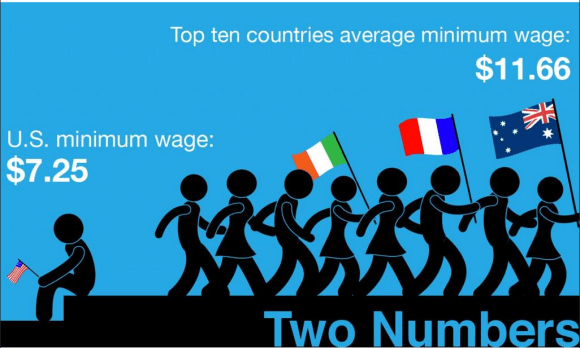
You can’t just throw numbers on an image and call it an infographic. See my “infographic” below.

Cheers.
The Sabermetric Revolution book reading
This past Thursday, I attended a book reading at Booklinks Booksellers in Northampton, MA. Benjamin Baumer and Andrew Zimbalist were reading from their new book, The Sabermetric Revolution: Assessing the Growth of Analytics in Baseball. Approximately 30 baseball starved fans braved the cold New England night to learn a few things about sabermetrics and baseball analytics. It was a very informative hour that included the reading of a few book excerpts, a lively Q&A session, and complimentary wine. What could be better on a February night than good baseball discussion and free alcohol!
Andrew Zimbalist is the Robert A. Woods Professor of Economics at Smith College and a noted sports economist who has written numerous books concentrating on the business of sports, especially baseball. Benjamin Baumer is a Visiting Assistant Professor at Smith College who spent eight years working as a Statistical Analyst for the New York Mets. The Sabermetric Revolution is their first joint project.

Professor Zimbalist opened up the event by reading from the preface of their new book. At the outset, Zimbalist made clear that a major focus of the book is debunking numerous statistical myths and cause and effect relationships about baseball that were promulgated in the book Moneyball by Michael Lewis and the subsequent movie starring Brad Pitt. The authors take no punches in lambasting Lewis for gross inaccuracies in his 2003 book. Zimbalist stated that Michael Lewis fell in love with a story and dramatically overplayed some of the success of the 2002 Oakland Athletics as sabermetric in source.
Professor Baumer continued the event by reading a brief excerpt from Chapter 2. He discussed the rise in use by most MLB franchises of sabermetric analysis in direct response to the popularity of Moneyball. Considering Baumer’s direct experience with the industry, his insight into the actual operations and use of statistics in baseball was fascinating and very eye opening.
After a joint discussion between the two authors about the use and application of the various baseball analytical metrics currently en vogue, the floor was opened to questions from those in attendance. Many of the audience questions focused on Baumer’s experience with the Mets and his opinion of the utility of sabermetrics on the baseball industry. The authors made a point of stating that many newly coined statistics are still in their infancy and their exact utility has yet to be truly discovered. They specifically mentioned Ultimate Zone Rating (UZR) as a statistic that has yet to prove its true usefulness as a real world baseball application.
One audience member asked if players have used these advanced metrics to change their approach to the game. Baumer responded that when he was with the Mets, the baseball operations staff pleaded with the field manager and coaches to convince Jose Reyes to walk more from the leadoff spot. He did, and his impact on the field from the top of the batting order substantially increased. However, Baumer noted that this was an exception to the general rule. In a broader sense, using sabermetrics to find the player you need rather than to change the player you have seems to be the more successful application.
One gentleman asked if there has been any evidence that other sports use statistical analysis. The authors responded that while baseball is unique in that players have such individualized contributions to their team, there has been some proof of its applicability to football and basketball in particular. Baumer noted that current Boston Celtics coach Brad Stevens used statistical analysis in his time coaching the overachieving Butler University Bulldogs.
The evening closed with Zimbalist and Baumer reemphasizing the purpose of their book. Ten plus years after Moneyball was published, they wanted to take a critical look at what parts of sabermetrics work, what parts don’t, and how the sports and industry of baseball is evolving while using analytical tools.
As an aside, I am currently reading the book and thus far I’m most fascinated by the career trajectories of the much heralded 2002 Oakland Athletics amateur draft class. Lewis went out of his way to talk about the advanced statistical tools used to make the draft selections, and now 11 years later Baumer and Zimbalist revisit the draft and the players that the Athletics took. Needless to say, the actual careers of most of the players highlighted by Lewis did not exactly match the accolades espoused in the book.
If you are interested in baseball and sports analytics, this book is a must read.
An inside look at the Sloan Sports Analytics Conference research paper contest
(Update: Click here for Part II, as Sloan updated its ticket policy and is now awarding all poster-winners 1 free ticket)
The Sloan Sports Analytics Conference (SSAC) has sold out every year since its 2006 inception, garnering the attention of ESPN, the New York Times, Time Magazine, and countless other worldwide media outlets, while promoting, according to its website, “the increasing role of analytics in the global sports industry.” This year, the conference will be held in Boston on February 28 and March 1.
One of the most academic portions of SSAC is its research paper contest (RP), which begins each year in September with an abstract submission, and, for worthy candidates, ends with a lengthy paper due in January. This year, I was one of a likely several dozen finalists (organizers did not offer the actual number of paper submissions) whose initial abstract was accepted…
View original post 2,618 more words
 Stats in the Wild