MLB Rankings – 4/17/2013
StatsInTheWild MLB rankings as of April 17, 2012 at 5pm. SOS=strength of schedule
| Team | Rank | Change | Record | ESPN | TeamRankings.com | SOS | Run Diff |
| Atlanta | 1 | ↑1 | 12-2 | 1 | 1 | 13 | +42 |
| SF | 2 | ↑1 | 9-5 | 4 | 5 | 7 | +5 |
| Colorado | 3 | ↑4 | 10-4 | 19 | 6 | 8 | +18 |
| Oakland | 4 | ↓3 | 11-4 | 2 | 9 | 30 | +31 |
| Arizona | 5 | ↑1 | 8-5 | 8 | 8 | 5 | +15 |
| St. Louis | 6 | ↓2 | 8-5 | 5 | 2 | 16 | +31 |
| Washington | 7 | ↑1 | 8-6 | 3 | 11 | 6 | -12 |
| NY Mets | 8 | ↑6 | 7-6 | 15 | 14 | 9 | +19 |
| Boston | 9 | ↑2 | 9-4 | 11 | 3 | 26 | +27 |
| Philadelphia | 10 | ↑7 | 6-7 | 18 | 15 | 3 | -12 |
| Kansas City | 11 | ↓6 | 8-6 | 13 | 12 | 25 | +8 |
| LA Dodgers | 12 | ↑1 | 7-7 | 12 | 13 | 4 | -9 |
| Texas | 13 | ↓3 | 9-5 | 7 | 18 | 29 | +12 |
| Cincinnati | 14 | ↓5 | 6-7 | 9 | 16 | 14 | +8 |
| Pittsburgh | 15 | ↑6 | 6-7 | 24 | 17 | 12 | -11 |
| NY Yankees | 16 | – | 7-5 | 14 | 4 | 23 | +15 |
| Detroit | 17 | ↓2 | 8-5 | 6 | 7 | 28 | +25 |
| Baltimore | 18 | ↓6 | 7-6 | 10 | 10 | 20 | +6 |
| Toronto | 19 | ↑7 | 6-8 | 17 | 20 | 15 | -20 |
| Cleveland | 20 | ↑4 | 5-7 | 21 | 25 | 18 | -14 |
| Minnesota | 21 | ↓3 |
6-7 | 27 | 19 | 24 | -10 |
| San Diego | 22 | – | 4-10 | 29 | 24 | 1 | -19 |
| Chi Cubs | 23 | ↑2 | 4-9 | 26 | 22 | 11 | -14 |
| Seattle | 24 | ↑3 | 6-9 | 20 | 27 | 27 | -16 |
| Tampa Bay | 25 | ↓5 | 4-9 | 16 | 26 | 17 | -20 |
| Chi WSox | 26 | ↓7 | 6-8 | 22 | 23 | 19 | -8 |
| Milwaukee | 27 | ↑1 | 4-8 | 25 | 21 | 10 | -24 |
| Miami | 28 | ↑1 | 3-11 | 30 | 28 | 2 | -27 |
| Houston | 29 | ↓6 | 4-10 | 28 | 30 | 21 | -19 |
| LA Angels | 30 | – | 4-10 | 23 | 29 | 22 | -27 |
Past Rankings:
Top 25 MLB Pitchers so far
|
Cheers.
Guest Post: Robinson Cano and Aging
This post was written by Tim.
Note- I have decided to make this a two-parter, which is always a great sign. Like that episode of Magnum PI that was continued into an episode of Murder, She Wrote (I hope no one thinks I’m kidding. It happened, and it was terrific.) Part one is mainly a critical look at the article sparking this issue and part two will be my analysis of the situation, because I know where my bread is buttered- the top, duh. Anywho, on to part one.
Dave Cameron is a terrific baseball writer and analyst. I love Dave Cameron. If Dave Cameron was a flavor of ice cream, he’d be Hood’s Green Monster Mint. Dave Cameron does good work, writes in an engaging manner and runs USS Mariner, which is his blog about a shipwreck. He’s also a frequent contributor to David Cone’s favorite website, Fangraphs.com.
Last month, Cameron posted an article entitled “Robinson Cano and Second Base Aging Curves.” The point of the article is that despite lots of anecdotal evidence of second basemen falling off a cliff in their early- to mid-thirties, the evidence is scant and Cano, as an elite player, should age just fine so the Yanks should make him as rich as a king of Europe. Cano will finally be able to afford a computer.
As a side note, I once listened to the ESPN “Baseball Today” podcast, which featured Keith Law (he’d be Phish Food) among others, and was heavy on analysis. ESPN in their unending quest to be the most mediocre sports outlet possible, changed the podcast to “Baseball Tonight” and Buster Olney is the host, and it’s now a bunch of writers telling us the same boring things professional baseball writers tell us, interviewing players who say the same boring things baseball players say and not doing a lick of analysis. During Spring Training, Olney and one of my least favorite Tims, Tim Kurkjian spoke at length about the Cano contract extension situation, and they agreed that the Yankees should go Monty Brewster on him, and just dump all of the money on him. All of it.
But let’s focus on Cameron’s argument, here. Cameron starts by saying that there are number of good, productive second basemen who suddenly stopped being good, productive second basemen. He lists Edgardo Alfonso, Carlos Baerga, Marcus Giles, Chuck Knoblauch, Roberto Alomar and Chase Utley as our anecdotal reference group. And it’s true, these guys all played (or play, for Utley) second, and they all had a precipitous decline. But like Cameron says, it’s anecdotal. And do you know what anecdotes are worth? Not a darned lot. Sorry about my language there, but I get riled up. So let’s get quantifying.
First, Cameron posits that all those guys, your Baergas, your Alfonsos, your Gileses (or maybe that’s a plurale tantum?), were good but not as Cano. Cameron suggests using wRC+ as a measuring stick to find Cano’s peers through age 29 (Cano was 29 years old for most of the 2012 season) and then see how those peers aged out; from there we will see if Cano is a worthy gamble for a contract that would let him finance the John Carter sequel; Cano loved the first movie [citation needed]. For the uninitiated, wRC+ stands for “weighted runs created plus” and a thorough explanation can be found here. The stat accounts for park and league adjustments. It’s a nifty tool to see in one number how good of a batter someone is (it’s worth noting that Cameron is totally avoiding discussion of defense, and I suppose it’s fair. But it’s worth noting it. Much like it’s worth noting that in 2005 he said, of Cano, “In his prime, I think he could hit .280/.320/.400 while playing awful defense. Yipee.” I like the sarcastic Yipee. And, like Fred Dobbs can tell you, figuring out prospects is a tough job.
Anywho, Cameron doesn’says, “Over the last 50 years, there have been six second baseman (Cano included) who have put up a 130 wRC+ or better from ages 26 to 29.” That list is:
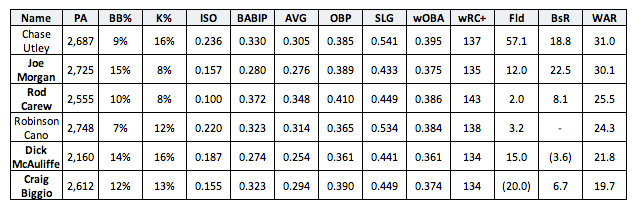
And here are the same players from age 31 on, which are the seasons Cano’s next contract will cover
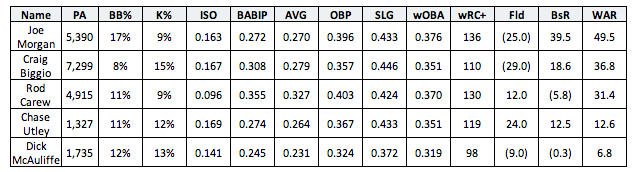
And here are the trends of those players:

Cameron notes that McAuliffe had the steepest decline, and was cooked at age 34. Cameron goes on to note, “[e]ven including McAuliffe, these five players averaged 3.5 WAR per season after they turned 31. Hardly a group that just fell apart after their prime was over.” Which is fair. Likewise, Cameron is fair by saying Utley, since he’s still active and is 34 in 2013, will likely see a bigger decline in his WAR. Fair all around. And based on what he’s seeing, even if we regress Cano, he expects him to produce 30 WAR for his career after he turns 31, and with inflation and the price of a win, Cano should be worth $210m or more. So go ahead Robbie, buy that superyacht. You’ve earned it via prediction.
Well, let’s actually think about this. First look at that list of CanoComps™. Those are some not-too-shabby folks to hang around. I’d hang around with those guys, if they’d have me. I don’t know what we’d talk about, but we could eat ice cream (real ice cream, not analogue ice cream that is actually baseball writers). I could probably bait Joe into talking about that terrible book Billy Beane wrote. But here’s the thing: I expected more players with some other criteria to show up (in Cameron’s article, not with my second baseman caucus), but this was the whole list. Five dudes.
Even deeper, though, are his criteria to form this five man list: ages 26-29 seasons with a wRC+ of 130 or higher. I think it’s totally fair to say that Robinson Cano has been an elite secondbaseman. Over the time period Cameron is looking at, 2009 to 2013, Cano had the sixth best wRC+ in all of baseball (by the by, Ben Zobrist, incidentally toes the line as number two, following the 2012 AL MVP. Zobrist is criminally underrated.) My issues with the set though are a) Cano had his only below-average year as a major leaguer in 2008, the year before the cutoff and b) wRC+ of 130 is elite, but it’s also extremely exclusive. Additionally, based on Cameron’s criteria we have what I call the “Carew Issue” (it rhymes, which makes it fun. If you don’t find it fun to say “Carew Issue,” I feel like you need to lighten up.) Through age 29, his Rodness was indeed an other-worldly hitter as second basemen. But time played some jokes on Rod Carew; not only is he probably now best known as a line in an Adam Sandler novelty song, he also only played 30 innings at second in the remaining 8797.2 innings of his career. Biggio (whose name does NOT rhyme with “issue,” for the record) is a little more defensible, though he did play 3491 innings at catcher before he switched to second at age 26, he also played his age 37 and 38 seasons in the OF. The problem here is that, if we’re trying to test if second base causes inherent problems for the men who play it, shouldn’t we try to have only second basemen?
And, finally, on our final analysis, Cameron switches from wRC+ to WAR. Both are good options for measuring performances, as far as I’m concerned, but they’re measuring different things. Runs Created, in any of its permutations, measures offensive production; WAR (what is it good for? ISN’T THAT JOKE ALWAYS HILARIOUS? No. it was never funny in any way) measures total production- offense, defense, baserunning (but not grittiness, sorry Justin Upton). Why’s that an issue? Well, if you look at WAR per 600 plate appearances (and I prefer WAR as a rate, rather than WAR, since it is a counting stat), using the same age range for second baseman, my 2B Ice Cream Social has a longer evite list:

I made my cut off 4 WAR/600PA. Lou Whitaker’s WAR/600PA is about 82% of Cano’s (incidentally, Cano’s is 77% of Utley’s.) So why is this problem matic? Well, outside of having more people, you can see how baserunning and fielding affect the WAR. Cano’s WAR is almost exclusively his offense; his defense is slightly above average (that’s the Fld score, in runs above average, of 5.3) and his baserunning is indeed perfectly average (BsR of 0). Pedroia , a good but not elite offensive player, has the second highest fielding score on the list, after only Utley. Utley, for his part, until age 29, was elite as a hitter, fielder and baserunner (I guess someone was practicing baseball instead of making runs to the White House in AC. That’s what we in the business call local color. Also, maybe I’ll get a free sandwich for the shout out. ) I personally don’t like measuring performance by one metric, and then making our prediction based on another. It’s not unlike having some sort of spaceship race and then measuring performance in how many parsecs it took.
I guess, in the end, there are some issues I have with how Cameron has put together his analysis. I think it’s great to look at comparable players to figure out overall trends, but if we’re so limited by our criteria, we will get almost no meaningful information. His conclusion is based on the careers of five men, one of whom fits the anecdote we’re trying to test, one who’s still in the midst his career (and has thus far actually kinda proved the anecdote), one who’s a first baseman, one who split time between second and center, and the best second baseman of all time. By our highly restrictive criteria, Cameron immediately (and admittedly) eliminated a larger number of guys who played well above average, but sub-elite baseball before they turned 30. If I’m the considering signing Cano, (which I am not, since I’m just a dude not a baseball team) I definitely want to see a great analysis to figure out the risk of drops in performance. Because, sometimes even if the player looks like an all-time great, a gigantic contract can still become something you regret.
I was talking about A-rod there, in case you didn’t catch it.
Also, remember, I really do like and respect Dave Cameron. Heckuva writer.
Top 25 MLB batters so far
Through April 17 at 12:34 am.
|
MLB rankings – 4/12/2013
StatsInTheWild MLB rankings as of April 12, 2012 at 8:15am. SOS=strength of schedule
| Team | Rank | Change | Record | ESPN | TeamRankings.com | SOS | Run Diff |
| Oakland | 1 | – | 8-2 | 9 | 3 | 30 | +33 |
| Atlanta | 2 | – | 8-1 | 2 | 1 | 16 | +26 |
| SF | 3 | – | 7-3 | 5 | 2 | 7 | +4 |
| St. Louis | 4 | – | 5-4 | 14 | 5 | 22 | +18 |
| Kansas City | 5 | – | 6-3 | 17 | 9 | 28 | +15 |
| Arizona | 6 | – | 6-3 | 15 | 7 | 5 | +15 |
| Colorado | 7 | – | 5-4 | 21 | 16 | 6 | +6 |
| Washington | 8 | – | 7-2 | 1 | 4 | 11 | 0 |
| Cincinnati | 9 | – | 5-4 | 4 | 6 | 20 | +12 |
| Texas | 10 | – | 7-3 | 6 | 10 | 29 | +11 |
| Boston | 11 | – | 5-4 | 12 | 17 | 27 | +15 |
| Baltimore | 12 | – | 5-4 | 8 | 11 | 25 | +9 |
| LA Dodgers | 13 | – | 6-3 | 11 | 8 | 4 | +3 |
| NY Mets | 14 | – | 5-4 | 22 | 20 | 9 | +11 |
| Detroit | 15 | – | 5-4 | 3 | 14 | 24 | +9 |
| NY Yankees | 16 | – | 4-4 | 23 | 15 | 1 | +9 |
| Philadelphia | 17 | – | 4-5 | 18 | 12 | 3 | -12 |
| Minnesota | 18 | – | 4-5 | 26 | 18 | 2 | -5 |
| Chi WSox | 19 | – | 4-5 | 16 | 13 | 21 | -4 |
| Tampa Bay | 20 | – | 4-5 | 10 | 19 | 19 | -12 |
| Pittsburgh | 21 | – |
3-6 | 25 | 23 | 12 | -13 |
| San Diego | 22 | – | 2-7 | 28 | 28 | 1 | -22 |
| Houston | 23 | – | 3-6 | 30 | 24 | 17 | -10 |
| Cleveland | 24 | – | 3-5 | 20 | 27 | 15 | -13 |
| Chi Cubs | 25 | – | 3-6 | 27 | 25 | 13 | -9 |
| Toronto | 26 | – | 3-6 | 13 | 29 | 8 | -24 |
| Seattle | 27 | – | 4-7 | 19 | 22 | 18 | -13 |
| Milwaukee | 28 | – | 2-6 | 24 | 26 | 10 | -17 |
| Miami | 29 | – | 1-8 | 29 | 30 | 2 | -24 |
| LA Angels | 30 | – | 2-7 | 7 | 21 | 14 | -18 |
Past Rankings:
Guest Post: I like baseball and I don’t like people who are willfully ignorant
Hello SitW readers. I’m Tim. I like baseball and I don’t like people who are willfully ignorant. Which would lead a reasonable person why I read the “Ask Nick” column on boston.com’s Extra Bases blog. I’d provide a link to the archive, except the brilliance of the website operated by the 25th most widely circulated newspaper in the country doesn’t actually have any sort of easy way to sort posts by author. Oh wellsies. It would probably break the internet to concentrate that level of Cafardosity, so they’re probably doing us a service.
If you’re not familiar with Nick Cafardo, he’s a sportswriter. He has been a sportswriter since the Hoover administration. He chain smokes three packs of cigars a day, wears a leather fedora and plaid suits and yells at his secretary to get people on “the horn” (that means the phonograph.) He wears loafers made out of milk cartons and he drives a BWI luggage cart to work every morning. I inferred this from the Boston Globe’s bio page of him, which includes information like “he’s a sportswriter” and “his name is Nick.” I had to connect the dots.
Anywho, Nick Cafardo is a professional sports writer. And Nick Cafardo answers emails. These emails are apparently not screened because they can be on any topic in regards to the Red Sox. There are a variety of subjects (play the GM, act-as-a-GM, General-Manager-in-the-mind, GM-thought-experiment express) and then Nick answers in one of three ways:
1) Evasion- often Nick simply ignores the question
2) Company line- Nick will also just say what you’d expect a Red Sox PR man would say
3) I don’t know- Nick claims not to know
Nick shows exactly the amount of baseball analytical skills you’d expect from someone whose career has been watching, thinking about, digesting, pooping out and coprophagically (don’t look it up!) ingesting it again. But sportswriters don’t do that. They don’t like analysis. It’s scary and weird and if RBI was good enough for ol’ Dougie MacArthur, it’s good enough for them.
If you read the internet, you may have seen a weblog called “Firebrand of the American League” which, as the name clearly implies, is about the Boston Red Sox. They run a column wherein they look at the Ask Nick column, then they basically answer the questions for Nick. But they’re also as funny as John Sununu at a Ski Resort. Man, I could have written for Murphy Brown. So with all due respect to them, and full credit that they did it first (though I’ve been doing it to an audience of me for ages) here comes Timmy to do the same. And yes it’s also FJM style too. I’m derivative. Sue me (DO NOT SUE ME).
(Bold– question, Italic– Nick’s answer, plain- probably very sarcastic and angry, also me)
The only three players in MLB right now that I would consider backing up the truckload of Red Sox farm club prospects for in a trade are: Madison Bumgarner, Yoenis Cespedis and Giancarlo (don’t call me Mike) Stanton. What do you think?
Bill, Modesto, Calif.
I’d say so. I’d probably do it for Miguel Cabrera and Felix Hernandez as well.
See what I mean by lazy? Bill from Modesto is asking if there are young players that Sox should unabashedly empty the farm for, suggesting a 23 year old pitcher who signed a reasonable contract through 2018 last summer, a guy that anyone could have had for just money a year ago, and Stanton, whom the whole planet expects to get traded. Nick suggests a 30 year old reigning MVP and a 27 year old who just signed a giant contract extension and has a slowing fastball and more innings on his arm than anyone else. Basically the one guy who MIGHT get traded here is Stanton and he hasn’t even entered arbitration. If we’re playing the game of guys who the Red Sox would empty the farm for, wouldn’t we talk about young, high-WAR guys like Mike Trout or Bryce Harper or Stephen Strasburg. Or if we want older guys, Ryan Braun or Robinson Cano or Justin Verlander.
But shouldn’t this discussion be MAYBE about guys who are LIKELY to get POSSIBLY traded. I guess Nick thinks that it’s more, uh, something, to play “let’s name good baseball players”.
With the likelihood of Stephen Drew starting the season on the DL growing ever larger, and Jose Iglesias taking over, what is the likelihood that, if Iglesias is able to hit respectably and continues to improve as he has shown this spring, of Drew getting traded once he comes back from his concussion?
Jacob, Ohio
Certainly a possibility. Because he was a free-agent signing, he can’t be dealt until June 15 unless he grants his permission. I’ve always thought Iglesias should be the starter anyway. I think Drew is a good player, solid hitter and above-average fielder. I’m not down on him at all, but I think they could have saved the $9.5 million there knowing they had an extraordinary defender at a defensive position. I know Sox execs believe a shortstop has to hit reasonably well in the American League, but he’s a run saver.
So here’s a fun game- imagine a really good defensive player. Then imagine a guy who couldn’t hit a beach ball with a wiffleball bat on an overcast day in the streets of Holyoke. Congratulations, you’ve just imagined someone who’s still a better hitter than Jose Iglesias. Wisdom of spending $9.5m on a reclamation project shortstop aside, Jose Iglesias in his three-year minor league career has managed an aggregate OBP of .318 and SLG of .306. To put that in perspective, in 2012, the closest batting comp to those numbers was Jemile Weeks, who OBP/SLG’ed .305/.304 and can’t even grow dreads as good as his brother (Honeysuckle Weeks). Weeks and Iglesias appear to have similar SB profiles (about 2/3 success). Weeks in 2012 managed an offensive WAR (BR variety) of a robust .5. The single best defensive player according to BR’s defensive WAR was M’s SS Brendan Ryan, who popped and locked a 3.6. Now, BR dWAR and oWAR both account for position, so you need to remove one positional adjustment. Doing so means that Iglesias, if he can match his minor league production (‘cause pitchers in the Majors are the same quality in the Minors, right?) and be the single best defensive player in baseball, his best-case BR WAR would be (based on 2012 levels) 3.1. Or the same as Brendan Ryan last year. Now that ain’t bad for someone who couldn’t hit a barn darn with a barn door hitting machine in Iowa (analogy gold, I tell you). And Stephen Drew’s max WAR over his career has been 3.7 in 2010. So Nick is probably right. It’s his reasoning that dumb.
I’m wondering if they’ll ever give J.C. Linares a shot? He has respectable minor league numbers with glimpses of power, and is also a decent fielder who has played all three positions. Just curious about what you think?
Mario, Victoria, BC
He’s definitely a guy who has been lost in the shuffle. He’s a righthanded bat, who, as you say can play all three outfield positions. Yet his name never is mentioned in the mix for that extra outfield spot. They say good things about him but obviously they’re not sold on him.
“Lost in the shuffle”? I guess in Nick’s world, the front office at Fenway has a stack of index cards with their minor league players’ names written on them, and then one day Tom Werner’s old friend Malcolm Jamal Warner visited and was recreating the Cosby Show episode where all the men are pregnant and then they give birth to inanimate objects. And he had Elvin give birth to the card with Linares name on it, but in the uproarious laughter, he dropped the card behind a plant, and the Sox just completely lost track of this guy they had in their system.
Here’s the scoop, Linares is 28. He played in AAA in 2011 and started 2012 in AA. In season and a a half of AAA ball, he’s OBP’ed a robust .312. If he was a catcher, it wouldn’t be a “thang”, as they say. The Sox sure do love catchers who don’t get on base . Anywho, rather than “not being sold on him” as if he were some sort of magic chamois being sold by Anthony Sullivan (in memory of Billy Mays), perhaps he just isn’t that good and is just taking up space in the cabinet. Like infomercial chamois. Holy crap, my metaphor broke down…
Why didn’t the Sox try and get Youk back?
Michael, Boynton Beach, Fla.
They thought Napoli would do more for them and if healthy, that’s the better choice. Napoli should hit for more power and should drive in more runs. Youk has had down years the past three. It was the right move.
Now, I think Nick is on the right path. I don’t know what he’s doing on the path. Probably texting. Or sexting. Here’s the thing, the Sox cut ties with Youk in 2012. They moved him to third, like jerkfaces, and it broke his back, as if it were Bane. But the guy is in his mid-30s, coming off two straight injury-shortened seasons, and the Yankees paid him $12.5 Million. Doesn’t exactly make sense to bring him back even if would have given a small discount, especially if your team isn’t one Greek God of Walks away from winning the AL pennant.
What kills me is the ‘Youk has had down years the past three,’ and not just from the awkward sentence construction. During the past two seasons, he’s been pretty banged up. But in 2010, he had a WAR of 5.1 which made him the 27th most valuable position player in the Majors, according to BR. The funny thing is, if you compare Napoli and Youkilis, with the exception of 2011, when Youk was hurt and Napoli was giving a big ol’ fat finger to the Angels for picking Jeff Mathis over him, Youk has been a much better player. Last year they were both hurt (Napoli missed 38 games to a thigh injury, Youk missed 29 games when his entire body fell off) and their WARs were practically even (Nap 1.4 vs Youk 1.1). They’re both past their primes. They’re both DeNiro in Rocky and Bullwinkle, but Youk usted be DeNiro Goodfellas and Napoli was more like DeNiro in Backdraft. Youk’s really been the better player. Who is actually the better bet in 2013? The answer is probably neither.
Any whispers about a possible trade by the Red Sox? It would seem they have a lot of pieces to move for a power hitting outfielder.
Michael, Hebron, Conn.
They seem to be looking for depth in starting pitching. Maybe pick up a veteran arm they can stick at Triple-A. They’re looking to see if there’s anyone out there better that the Nava-Overbay-Carp-Sweeney group. Not sure a big deal for a Giancarlo Stanton could be made at this time.
As Nick sort of says, the Red Sox have about forty three corner outfielders. But here’s a chance to do something Nick doesn’t actually like to do, ie make his readers slightly more knowledgeable baseball fans. For instance, fun fact: trades almost never happen this close to opening day. Rosters are generally set and teams like to at least see what they have before moving parts or calling it a season. In 2012, the first major deal was June 24, the aforementioned Youkilis deal. In 2011, the first “major” deal was June 30, Mark Ellis goes to the Rockies from the A’s. In 2010, July 1, Benjie Molina (a spare part after the Posey call-up) to Texas. Like wearing white before (or is it after? Or maybe on?) Labor Day, teams just don’t do this sort of thing.
If MLB was re-drafting every team (just go with me) and each franchise got to keep one veteran and one prospect, who do you think the Sox should go with? Contracts are irrelevant.
Adrian, Milford, Mass.
Middlebrooks (veteran) and Bogaerts. If you don’t classify Middlebrooks as a veteran, then Pedroia.
Yup. 75 game veteran, Will Middlebrooks. Hardened by his 267 at bats. Worn like an old piece of leather from his 13 walks and 70 strike outs and HOLY CRAP, LOOK AT THAT WALK TO STRIKEOUT RATIO!
I’m going to take a moment to indulge myself in something that bugs me. Will Middlebrooks certainly seems like he has some solid power. But seriously, in a VERY SMALL SAMPLE SIZE, his MLB BB/K% was 0.186%. The worst BB/K% in 2012 of all qualified major league batters was Delmon Young at 0.179%. If Middlebrooks improves to his minor league career BB/K%, he’s going to be at .285%, which puts him in the coveted Jeff Francoeur/Alex Rios neighborhood. When your upside is Jeff Francoeur, ya’s gots some problems.
I have more than 40 years of medical experience. If Ortiz did not have hyperbaric oxygen therapy, he did not, then, have “the best treatment available.” The medical situation in Boston perplexes me. Supposedly it, like Houston, is a center of medical expertise. I am doubting that now.
Vicente, Cali, Colombia
This is a very passionate subject for you, doctor. I will try to ask if this hyperbaric oxygen therapy has been thought of or is being utilized.
Fun fact: this Colombia physician had multiple questions in the previous Ask Nick column. That’s ritght, same guy, multiple questions, SAME SUBJECT, referencing Ortiz and hyperbaric oxygen treatment. Now Nick does these columns every two weeks. If he cared enough to publish these questions repeatedly, you’d think he would have cared to use those questions from two weeks ago this same fella, and inquire about this hyperbaric oxygen. But he’ll “try to ask” now.
I don’t think the starting staff and certainly the bullpen looks all that bad. I was watching a Yankees spring game and the announcers predicted a 75-win, last-place finish for the Sox. Maybe they should look in the mirror. I know the hitting is average at best, but pitching, pitching, defense, hitting in that order wins pennants. What do you think?
Grampy Z, Zephyrhills, Fla.
They’re entitled to their opinion. The Yankees are starting the season really decimated with injuries so you’re right, they’re not in the best position either. It’s always harder to project a 95-win team going to last place rather than a 69-win team making the playoffs. The Yankees had the best starting rotation in the AL East last season and it could be again, but you wonder about Kuroda and Pettitte pitching at their respective ages and staying healthy all year. If they do, they will survive the positional injuries and be good again. I’ve definitely upgraded my Red Sox outlook since camp began. Red Sox starting pitching has made great improvement. I try to temper it with it’s only spring training, but there’s a more optimistic view even with David Ortiz’ injury.
Grampy from Zephyrhills, FL, you listed pitching twice. I’ll assume that’s a typo. Anywho, first things first- “pitching wins titles” has been debunked. Repeatedly. In fact, a University of Delaware Professor, Charles Pavitt, published a scholarly article in the Oct 2011 Journal of Quantitative Analysis in Sports, and produced a conclusion so counterintuitive that your mind may be blown. You’ve warned: Professor Pavitt looked at every baseball team that played in the Majors from 1955-2008 and found, SHOCKINGLY, that defense and offense contribute to wins equally. In fact, because defense is broken up into fielding and pitching, pitching actually contributes approximately half as much to winning as hitting. Meaning, Grampy from Zephyrhills’s list being “in that order” is not just wrong, but very wrong. Nick could have spent 20 seconds internet-searching, or he could have kept up on this sort of this thing by reading interesting articles about baseball. He could have educated his readers and shown that with a little bit of hard work (THAT OTHER PEOPLE ALREADY DID) you can find out that old adages and guys writing in from a Florida town that sound suspiciously made-up might not be right. Instead, Nick told us, “It’s always harder to project a 95-win team going to last place rather than a 69-win team making the playoffs.” To which I say, that makes no sense and doing either is equally easy because pre-season projections are almost always meaningless
____________________
He has more questions, but some of those are good questions like “How do reporters get around spring training?” and “Who will make the opening day roster as catcher?” and “Are those milk carton loafers comfortable?” You know, questions that a beat reporter could answer without trying to hard. Which is what Nick Cafardo seems to do best.
Sweet 16 locks: Florida, Arizona (or Belmont), and Saint Louis
Last year my first round submission to Stat Geek Idol was “Predicting the Sweet Sixteen with a Classification Tree.” My two big suggestions were to 1.) not get overly excited about Florida State or Michigan and 2.) the 14 seeds looked good. Looking back, neither Florida State nor Michigan made it to the Sweet Sixteen, but none of the 14 seeds won any of their games. (Though just about every other seed did including 9,10,11,12,13, and 15. Nearly all the lower seeds EXCEPT for 14.)
So, I was right about some things and wrong about others. You cant win them all. Though I did get one strong endorsement from Tweeter @ClevTA who claims that my classification tree helped him win his pool, besting about 350 other entries. Let’s look at what the classification tree predicts this year.
The first split is based on RPI of 0.6169. Teams above this threshold will be the R groups (right hand side of the tree image below) and teams below the threshold with be the L groups. Overall, in the years used to build the model, teams in the R group advanced to the Sweet Sixteen about 67 percent of the time, whereas teams in the L group advanced just less than 10 percent of the time.
The R group teams this year are Duke, New Mexico, Louisville, Miami (FL), Kansas, Gonzaga, Florida, Indiana, Michigan State, Georgetown, Ohio State, Marquette, Memphis, Syracuse, Arizona, North Carolina, Michigan, Kansas State, Belmont, Saint Louis. All the other teams are in the L group.

The R teams
The R group teams can be broken down into 4 more sub-groups R1-R4. Teams in the R1 group qualify for the Sweet Sixteen about 91% of the time and every single team in the R2 group has qualified for the Sweet Sixteen of in the years used to build the model (2007-2011). On the other hand, teams in the R3 group have only qualified about 51% of the time, and no team in group R4 has qualified for the Sweet Sixteen between 2007 and 2011. So, who’s in each group:
R1 (91.18%): RPI >.643
(2)Duke, (3)New Mexico, (1)Louisville, (2)Miami (FL), (1)Kansas, (1)Gonzaga
R2 (100%): RPI>0.6169 & RPI <0.643 & Opp.Effective.Poss.Ratio<0.9147
(3)Florida, (6)Arizona, (11)Belmont, (4)Saint Louis
Of course all four of these teams can’t make it to the Sweet Sixteen as Arizona plays Belmont in the Second (nee First) round of the tournament.
R3 (51.61%): RPI>0.6169 & RPI <0.643 & Opp.Effective.Poss.Ratio>0.9147 & Avg.2nd.Half.Margin>2.998
(1)Indiana, (3)Michigan State, (2)Georgetown, (2)Ohio State,, (6)Memphis, (4)Syracuse, (4)Michigan,
R4 (0%): RPI>0.6169 & RPI <0.643 & Opp.Effective.Poss.Ratio>0.9147 & Avg.2nd.Half.Margin<2.998
(3)Marquette, (4)Kansas State, (8) North Carolina [Correction: In the original post, I had Marquette and Kansas State in the R3 group. They should be in the R4 group.]
The L teams
L1 (5.34%): RPI < 0.6169 and Assists.Turnovers<1.317
Notables: (5) Oklahoma State, (5) VCU, (5) UNLV, (6) Memphis, (6) Butler, (7) Illinois, (7) San Diego State
Butler and VCU have both advanced to the Sweet Sixteen out of this group before.
L2 (17.86%): First Split RPI < 0.6169 and Assists.Turnovers>1.317 and Opp Pct Pts From 2 >=.5133
(7)Notre Dame, (6)UCLA, (11)Bucknell, (7)Creighton, (9)Temple, (5)Wisconsin
L3 (66.67%): RPI < 0.6169 & Assists.Turnovers>1.317 & Opp Pct Pts From 2 <.5133
(8)Pittsburgh
2011 Results
Teams that Made the Sweet Sixteen in Bold
R1 (5/6): Syracuse, Michigan State, Kentucky, North Carolina, Kansas, Duke
R2 (1/1): Ohio State
R3 (3/7): Marquette, Baylor, Indiana, Missouri, Georgetown, Wichita State, Memphis
L1 (6/45): Wisconsin, Cincinnati, Louisville, Xavier, Ohio, North Carolina State, The remaining 39 teams.
L2 (1/9): Florida, St. Mary’s (CA), Notre Dame, Creighton, Purdue, California, South Dakota State, Belmont, Iona
Cheers.
NCAA Tournament Projections – March 11, 2013
Here is the bracket that I projected on March 5th and here is the updated bracket from March 11th. Also, for your viewing pleasure, here are my projected tournament seeds and my my full rankings as of today at noon.
Some notes
- Louisville moves up to a 1 seed, and Indiana drops to a 2.
- Pittsburgh drops from a 2 seed to a 3 seed.
- I now have Stanford out and Colorado in.
- Creighton moves up from a 9 seed to a 7 seed.
- Last four in: Baylor, Virginia, Wichita State, and Colorado
- First four out: Stanford, Villanova, Arizona State, La Salle
- I have 8 Big Teams in and 7 from the Big East.
- Big 12 gets 6 team, ACC gets 5 teams, Mountain West gets 5 teams, and the SEC, Atlantic 10, and Pac-12 all get 4 teams.
- The Missouri Valley Conference and the West Coast Conference both get two teams in. All other conferences get 1 team.
- I have Liberty, who qualified for the NCAA tournament by winning their conference with a record of 15-20, ranked with the 309th best resume out of 345 and 268th in my predictor rankings.
March Madness Projections Updated – March 5, 2013
Number 1 Seeds: Gonzaga, Indiana, Michigan, Duke
Last 4 in: Boise State, Wichita State, Virginia, Stanford
Last 4 out: California, La Salle, Arizona State, Baylor
 Cheers.

From flight stats, describing a flight that is the first leg of a two-leg itinerary I’m flying in the near future – obviously this is the sort of flight where one is interested in knowing whether it tends to be on time, because one does not like being stuck in Charlotte:
This flight has an on-time performance of 84%. Statistically, when controlling for sample size, standard deviation, and mean, this flight is on-time more often than 95% of other flights.
I didn’t realize one could control for standard deviation and mean.
(Presumably controlling for “sample size” could mean some Bayesian approach, where if there is a small amount of data for a flight they tend to give moderate predictions. This is probably not too influential as flight stats uses a sixty-day window.)
 Stats in the Wild


