Category Archives: Academia
Some ENAR pictures
Here is a view of the Capitol from just outside of ENAR.

OBEY.
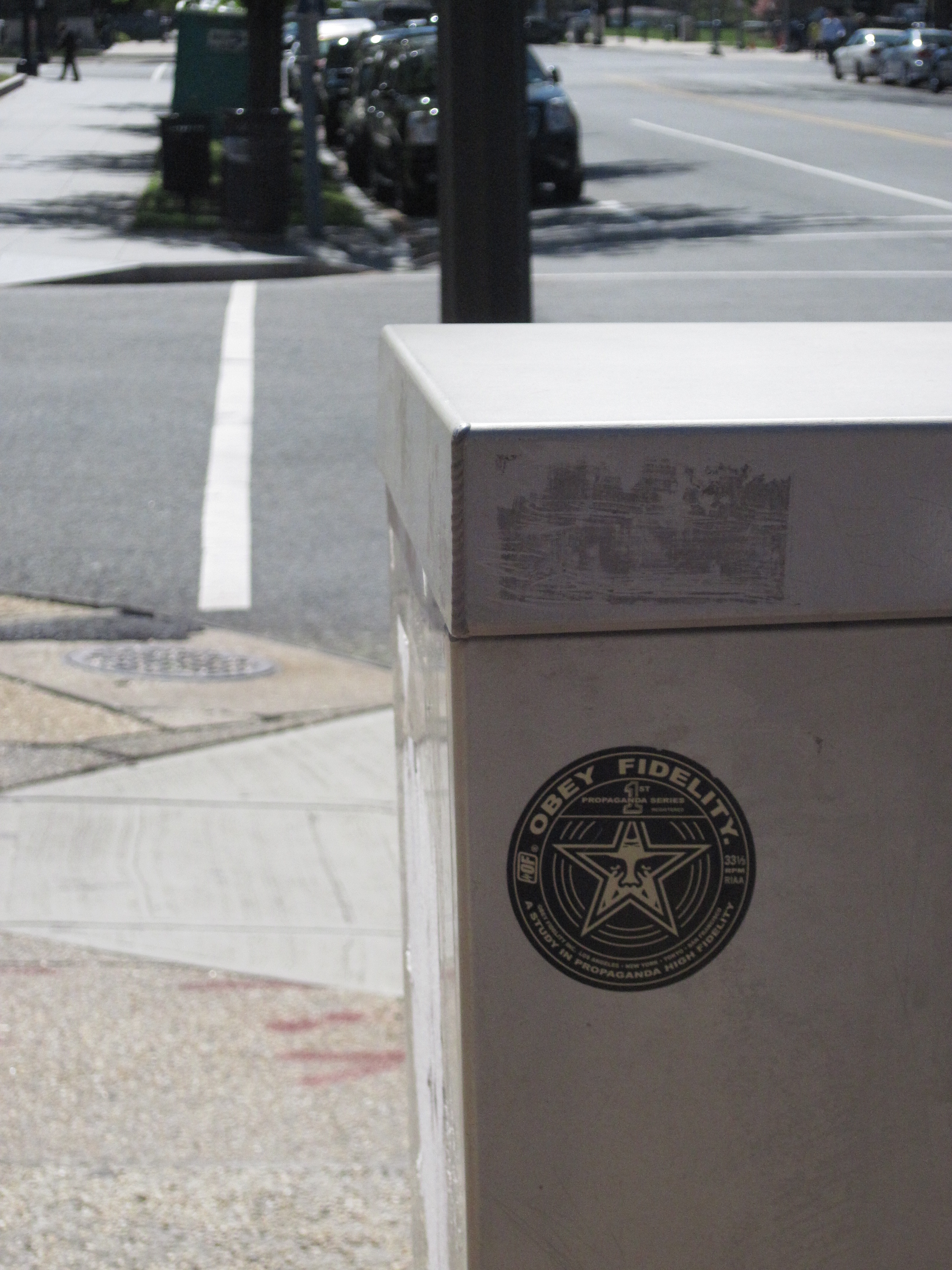
And finally, for @CM_Litchfield, a picture of the Teamester’s headquarters.

Cheers.
An interesting debate: Gelman vs Freakonomics
- Freakonomics was published.
- Gelman and Fung write: Freakonomics: What Went Wrong?
- Freakonomics Responds.
- Gelman gets “meta”
Nan Laird is speaking at Smith College today. Go.
Nan Laird is speaking at Smith College today at 5pm. You should probably go to this.
Finding Genetic Markers for Disease: Some Challenges and Opportunities for Biostatisticians, Thursday, March 15, 5 p.m., McConnell B15
Nan Laird, Professor of Public Health and Biostatistics, Harvard School of Public Health. In the relatively short time span of less than 10 years, association analysis has become the primary study design for finding genes underlying complex disorders. Genome Wide Association Studies have discovered hundreds of new genetic markers which predict disease. Early successes with association analysis led to great excitement about the promise of GWAS for understanding the genetic basis of complex disease. Although the number of GWAS studies has proliferated rapidly, replications are often disappointing and Meta-Analysis has become an essential part of the process of gene discovery. This talk will review some features of GWAS that offer challenges and opportunities for Biostatisticians.
EigenBracket 2012: Using Graph Theory to Predict NCAA March Madness Basketball
An interesting post from BioPhysEngr Blog:
EigenBracket 2012: Using Graph Theory to Predict NCAA March Madness Basketball
Cheers.
5th Moment
I don’t really know what to say about this. It appears to be a band comprised of statistics graduate students at North Carolina State who sing about statistics to the tune of popular songs. I’m really, truly speechless.
Here are the lyrics:
The Fifth Moment’s performance at the 2012 International Dinner! We are the original NCSU Graduate Statistics band! Follow us on Twitter, @TheFifthMoment. Lyrics below:
Vocals / Keyboard: Bradley Turnbull and Kristin Linn
Lead Guitar: Sidd Roy
Rhythm Guitar: Joe Usset
Bass : Kyle WhiteLyrics by Kristin Linn.
Original: Super Bass by Nicki Minaj and Baby by Justin Bieber
(We of course do not own any part of this song hybrid – thanks to Nicki Minaj and Justin Bieber for creating the parts.)This one is for the boys with the distributions
on their parameters, they be prior choosin’
and over model space, they be samplin’ up
Markov chains with reversible jump.And he cool, got tools, he might have a rule
that minimizes risk and when I see him at school,
I trip, I flip, wanna kiss him on the lip
’cause with a Bayes factor, he’s so freakin’ hip.Conjugate or not not, do you think I’m hot hot?
Based on my posterior, do I have a shot? Oh!
You’re the kinda guy I was lookin’ for
’cause your unknowns are random, yo.I said, excuse me, you’re a heck of a guy,
I mean, my my my my, MCMC is fly, I mean,
You’re not shy ’round empirical types,
and your estimates perform like a frequentist’s might, oh!Yes I did, yes I did.
I need an introduction cause I aint Sidd
I am Kristin Linn, I love statistics, I take limits.Multiply my likelihood by your prior.
Be my conjugate and I’ll take you higher.
Don’t you love those bay bay bay bay bay bay bay bay Bayesians, super Bayes,
bay bay bay bay bay bay bay bay Bayesians, super Bayes.You have an unknown
you want to find.
Give it a prior,
and multiply by
the likelihood
of your data.
Ignore that constant denominator.Now you have it,
a posterior.
How will you use it?
The choice is yours.
Forget your p-values tonight.
I’m 95% sure you’ll be alright!Bayes rule it will set you free.
No more p-values and finally,
don’t need that crazy closed form density.
Sample from it using MCMC, yeahIf objective is the way to go,
under transformation one can show,
there’s a prior invariant and so,
thank you Jeffreys, you are my hero, ohWhen I was 22, I had my first love.
His name was Bayes, no it wasn’t just a phase,
and we used to stay up all night using WinBUGS.
Sampling with MCMC, oh I was star struck.
He woke me up daily, don’t need no Starbucks!
We’d go on random walks,
diagnose all our problems of convergence with
autocorrelation plots.
He was really good at minimizing his risk.
He knew he had me dazing
cause he was so amazing.
Freq 3:16 is fading
’cause now I keep on saying…Bayes rule it will set you free.
No more p-values and finally,
don’t need that crazy closed form density.
Sample from it using MCMC, yeahBayesians ’round the world agree
both objective and subjectively.
it makes sense to update prior beliefs.
Bayes I love you, you’re the one for me, me.
Cheers.
HaRRy PotteR
The title of this post is supposed to be HaRRy PotteR, but unfortunately the blog style capitalizes all of the letters
A very brief introduction to R….in terms of harry potter.
Cheers.
“Rethinking my Science” – Society for Personality and Social Psychology
An interesting article by Charles Stangor: “Rethinking my Science”
And a quote from it:
First is the paper by Henrich, Heine, and Norenzayan (2010) on the use of WEIRD samples. These authors argue that our usual college student samples (White, Educated, Intelligent, Rich, and Democratic) are just terrible – that we cannot expect them to generalize very far, and that we desperately need to expand them.
I was trained, and have always trained my students, that “since we can’t get a representative sample of the population of interest (everyone), then we might as well study college students as they are convenient.” This belief was so dear to me that I fully expected to find that the many respected scientists who responded to the target paper would buy into this logic – it just seems so reasonable! But with some exceptions (e.g. Gaertner, Sedikides, & Brown, 2010), they did not. It appears that many – even most – scientists agree that samples used by social psychologists are flawed and that our conclusions are therefore invalid.
Cheers.
Academic Spring
I’ve been reading a lot about the boycott against Elsevier lately, and today I came across this article from slate.com called “The other academic freedom movement”. As I’ve moved along through graduate school and published a few articles, I’m a little bit surprised at some of the strange forces at work in the whole peer-review process. It seems to me that, and others have pointed this out, that scientists write articles for free, then get them peer-reviewed for free, then give away their copyright to a publisher who then make a ton of money. (Thats how Elsevier made $1.1 billion last year.) I resent the idea that some CEO of a publishing company is making millions of dollars a year off of the work of scientists at universities who are making a fraction of that. (How different is this than the CEO of a college bowl game making millions while the athletes get nothing but tuition?) Of course, the problem isn’t that simple. This is science and a big part of science is to share work with as many other people as possible. Science needs this communication with other scientists and a peer-review process. What if there were a way to get both of these without a publisher?
In my mind, at this point in time, a journal is just a stamp of approval. It’s just an abstract concept. In the past, journals needed to be physically published. It was the only way. But now I can publish whatever I want (this blog for instance), and it will reach potentially everyone one earth with an internet connection. So why not start an “abstract journal.” No head quarters, no profits, no business plan. Just a group of editors and experts who put their stamp of approval on the work you have done. If you’re work is accepted, it’s up to the author to make his work freely available on the internet somewhere (like a wordpress blog, which is free). The editor of the journal would simply post a list of accepted work with links to accepted articles, and anyone in the world could access this whether they are a top research scientist or just a curious individual with an internet connection.
Cheers.
Mindless Statistics
Below is the opening paragraph of the article Mindless Statistics by Gerd Gigerenzer (The bold was added by me):
I once visited a distinguished statistical textbook author, whose book went through many editions, and whose name does not matter. His textbook represents the relative best in the social sciences. He was not a statistician; otherwise, his text would likely not have been used in a psychology class. In an earlier edition, he had included a chapter on Bayesian statistics, and also mentioned (albeit in only one sentence) that there was a development in statistical theory from R.A. Fisher to Jerzy-Neyman and Egon S. Pearson. To mention the existence of alternative methods and the names associated with them is virtually unheard of in psychology. I asked the author why he removed the chapter on Bayes as well as the innocent sentence from all subsequent editions. “What made you present statistics as if it had only a single hammer, rather than a toolbox? Why did you mix Fisher’s and Neyman–Pearson’s theories into an inconsistent hybrid that every decent statistician would reject?”
To his credit, I should say that the author did not attempt to deny that he had produced the illusion that there is only one tool. But he let me know who was to blame for this. There were three culprits: his fellow researchers, the university administration, and his publisher. Most researchers, he argued, are not really interested in statistical thinking, but only in how to get their papers published. The administration at his university promoted researchers according to the number of their publications, which reinforced the researchers’ attitude. And he passed on the responsibility to his publisher, who demanded a single-recipe cookbook. No controversies, please. His publisher had forced him to take out the chapter on Bayes as well as the sentence that named alternative theories, he explained. At the end of our conversation, I asked him what kind of statistical theory he himself believed in. “Deep in my heart,” he confessed, “I am a Bayesian.”
If the author was telling me the truth, he had sold his heart for multiple editions of a famous book whose message he did not believe in. He had sacrificed his intellectual integrity for success. Ten thousands of students have read his text, believing that it reveals the method of science. Dozens of less informed textbook writers copied from his text, churning out a flood of offspring textbooks, and not noticing the mess.
Cheers.
 Stats in the Wild