Category Archives: R
MLB Rankings – 4/30/2012
StatsInTheWild MLB rankings as of April 30, 2012 at 8am.
| Team | Rank | Change | Record | ESPN | TeamRankings.com |
| Texas | 1 | – | 16-6 | 1 | 1 |
| St. Louis | 2 | ↑2 | 14-8 | 2 | 5 |
| Atlanta | 3 | – | 14-8 | 7 | 3 |
| LA Dodgers | 4 | ↑1 | 16-6 | 4 | 2 |
| Washington | 5 | ↓3 | 14-8 | 5 | 6 |
| Baltimore | 6 | ↑7 | 14-8 | 12 | 9 |
| NY Yankees | 7 | ↓1 | 12-9 | 6 | 7 |
| Tampa Bay | 8 | ↑3 | 14-8 | 3 | 4 |
| Toronto | 9 | ↓2 | 12-10 | 9 | 14 |
| San Francisco | 10 | ↑5 | 12-10 | 13 | 15 |
| Boston | 11 | ↑16 | 10-11 | 10 | 10 |
| NY Mets | 12 | – | 13-9 | 16 | 11 |
| Arizona | 13 | ↑4 | 11-11 | 15 | 19 |
| Chicago WSox | 14 | ↓6 | 11-11 | 19 | 12 |
| Cincinnati | 15 | ↑9 | 11-11 | 17 | 16 |
| Philadelphia | 16 | ↑2 | 10-12 | 11 | 22 |
| Cleveland | 17 | ↓3 | 11-9 | 14 | 23 |
| Seattle | 18 | ↑4 | 11-12 | 21 | 13 |
| Colorado | 19 | ↓3 | 10-11 | 18 | 18 |
| Miami | 20 | ↓10 | 8-13 | 23 | 25 |
| Detroit | 21 | ↓12 | 11-11 | 8 | 8 |
| Oakland | 22 | ↓2 | 11-12 | 22 | 21 |
| Houston | 23 | ↓4 | 8-14 | 26 | 24 |
| Pittsburgh | 24 | ↑1 | 9-12 | 25 | 17 |
| Milwaukee | 25 | ↓2 | 10-12 | 20 | 20 |
| LA Angels | 26 | ↓5 | 7-15 | 24 | 28 |
| Chicago Cubs | 27 | ↑2 | 8-14 | 28 | 27 |
| San Diego | 28 | ↓2 | 7-16 | 29 | 26 |
| Kansas City | 29 | ↓1 | 6-15 | 27 | 30 |
| Minnesota | 30 | – | 6-15 | 30 | 29 |
Past Rankings:
Cheers.
MLB Rankings – 4/23/2012
StatsInTheWild MLB rankings as of April 22, 2012 at 9pm.
| Team | Rank | Change | Record | ESPN | TeamRankings.com |
| Texas | 1 | ↑1 | 13-3 | 1 | 1 |
| Washington | 2 | ↑1 | 12-4 | 6 | 6 |
| Atlanta | 3 | ↑8 | 10-6 | 13 | 3 |
| St. Louis | 4 | – | 11-5 | 3 | 8 |
| LA Dodgers | 5 | ↓4 | 12-4 | 5 | 5 |
| NY Yankees | 6 | ↑4 | 9-6 | 4 | 9 |
| Toronto | 7 | ↓1 | 9-6 | 11 | 13 |
| Chicago WSox | 8 | ↑1 | 9-6 | 9 | 4 |
| Detroit | 9 | ↓4 | 10-6 | 2 | 2 |
| Miami | 10 | ↑9 | 7-8 | 21 | 20 |
| Tampa Bay | 11 | ↑13 | 9-7 | 8 | 11 |
| NY Mets | 12 | ↓3 | 8-6 | 10 | 7 |
| Baltimore | 13 | ↓1 | 9-7 | 18 | 12 |
| Cleveland | 14 | ↑3 | 8-6 | 23 | 10 |
| San Francisco | 15 | ↑1 | 7-7 | 14 | 16 |
| Colorado | 16 | ↑3 | 8-7 | 19 | 24 |
| Arizona | 17 | ↓10 | 8-8 | 7 | 21 |
| Philadelphia | 18 | ↓3 | 7-9 | 12 | 17 |
| Houston | 19 | ↓1 | 6-10 | 26 | 22 |
| Oakland | 20 | ↑2 | 8-9 | 24 | 26 |
| LA Angels | 21 | – | 6-10 | 17 | 27 |
| Seattle | 22 | – | 7-10 | 22 | 15 |
| Milwaukee | 23 | ↑4 | 7-9 | 16 | 14 |
| Cincinnati | 24 | ↓1 | 7-9 | 20 | 18 |
| Pittsburgh | 25 | – | 6-9 | 28 | 19 |
| San Diego | 26 | ↑3 | 5-12 | 30 | 29 |
| Boston | 27 | ↓14 | 4-10 | 15 | 23 |
| Kansas City | 28 | ↓2 | 3-12 | 25 | 30 |
| Chicago Cubs | 29 | ↓1 | 4-12 | 27 | 28 |
| Minnesota | 30 | – | 5-11 | 29 | 25 |
Cheers.
MLB Rankings – 4/16/2012
StatsInTheWild MLB rankings as of April 16, 2012 at 8am.
| Team | Rank | Change | Record | ESPN | TeamRankings.com |
| LA Dodgers | 1 | ↑1 | 9-1 | 5 | 4 |
| Texas | 2 | ↑1 | 8-2 | 1 | 2 |
| Washington | 3 | ↑1 | 7-3 | 6 | 5 |
| St. Louis | 4 | ↑1 | 7-3 | 3 | 6 |
| Detroit | 5 | ↓4 | 6-3 | 2 | 3 |
| Toronto | 6 | ↑1 | 5-4 | 11 | 11 |
| Arizona | 7 | ↓1 | 6-3 | 7 | 9 |
| NY Mets | 8 | ↑3 | 6-3 | 10 | 7 |
| Chicago WSox | 9 | ↑1 | 5-3 | 9 | 1 |
| NY Yankees | 10 | ↓2 | 5-4 | 4 | 13 |
| Atlanta | 11 | ↑9 | 5-4 | 13 | 12 |
| Baltimore | 12 | ↑1 | 5-4 | 18 | 16 |
| Boston | 13 | ↑18 | 4-5 | 15 | 8 |
| Seattle | 14 | ↑2 | 6-5 | 22 | 14 |
| Philadelphia | 15 | ↓1 | 4-5 | 12 | 19 |
| San Francisco | 16 | ↓2 | 4-5 | 14 | 18 |
| Cleveland | 17 | ↑12 | 4-4 | 23 | 15 |
| Houston | 18 | ↓3 | 4-5 | 26 | 24 |
| Miami | 19 | ↑2 | 4-6 | 21 | 23 |
| Colorado | 20 | ↓1 | 4-5 | 19 | 21 |
| LA Angels | 21 | ↑3 | 3-6 | 17 | 29 |
| Oakland | 22 | – | 4-6 | 24 | 27 |
| Cincinnati | 23 | ↑3 | 4-6 | 20 | 17 |
| Tampa Bay | 24 | ↓15 | 4-5 | 8 | 10 |
| Pittsburgh | 25 | ↓2 | 3-6 | 28 | 22 |
| Kansas City | 26 | ↓14 | 3-6 | 25 | 28 |
| Milwaukee | 27 | ↓10 | 4-6 | 16 | 20 |
| Chicago Cubs | 28 | ↓3 | 3-7 | 27 | 26 |
| San Diego | 29 | ↓2 | 2-8 | 30 | 25 |
| Minnesota | 30 | ↓2 | 2-7 | 29 | 30 |
Cheers.
MLB Rankings – April 13, 2012 (Friday 13th edition)
StatsInTheWild MLB rankings as of April (Friday) 13, 2012 at noon.
Some interesting things:
- SITW, ESPN, and TR all have the Tigers number 1 and the Yankees ranked 8.
- My top 10 has all of the same teams in it as TeamRankings.com except for one team: Toronto.
- My top 10 has all of the same teams in it as ESPN except for 2 teams: LA Dodgers and Chicago White Sox.
| Team | Rank | Change | Record | ESPN | TeamRankings.com |
| Detroit | 1 | – | 5-1 | 1 | 1 |
| LA Dodgers | 2 | – | 6-1 | 11 | 3 |
| Texas | 3 | – | 5-2 | 4 | 5 |
| Washington | 4 | – | 5-2 | 9 | 7 |
| St. Louis | 5 | – | 5-2 | 6 | 4 |
| Arizona | 6 | – | 5-1 | 3 | 6 |
| Toronto | 7 | – | 4-2 | 7 | 13 |
| NY Yankees | 8 | – | 3-3 | 8 | 8 |
| Tampa Bay | 9 | – | 4-2 | 2 | 2 |
| Chicago WSox | 10 | – | 3-2 | 22 | 9 |
| NY Mets | 11 | – | 4-2 | 17 | 11 |
| Kansas City | 12 | – | 3-3 | 21 | 18 |
| Baltimore | 13 | – | 3-3 | 20 | 21 |
| Philadelphia | 14 | – | 3-3 | 10 | 14 |
| Houston | 15 | – | 3-3 | 30 | 26 |
| Seattle | 16 | – | 4-4 | 19 | 12 |
| Milwaukee | 17 | – | 4-3 | 12 | 10 |
| San Francisco | 18 | – | 2-4 | 16 | 20 |
| Colorado | 19 | – | 2-4 | 18 | 29 |
| Atlanta | 20 | – | 2-4 | 23 | 24 |
| Miami | 21 | – | 2-5 | 14 | 25 |
| Oakland | 22 | – | 3-4 | 27 | 22 |
| Pittsburgh | 23 | – | 2-4 | 24 | 19 |
| LA Angels | 24 | – | 2-4 | 5 | 28 |
| Chicago Cubs | 25 | – | 2-5 | 28 | 23 |
| Cincinnati | 26 | – | 3-4 | 13 | 16 |
| San Diego | 27 | – | 2-5 | 29 | 15 |
| Minnesota | 28 | – | 2-4 | 26 | 30 |
| Cleveland | 29 | – | 1-4 | 25 | 27 |
| Boston | 30 | – | 1-5 | 15 | 17 |
Cheers.
Atomic vs recursive
So that’s what an atomic structure means.
R also operates on objects called lists, which are of mode list. These are ordered sequences of objects which individually can be of any mode. lists are known as “recursive” rather than atomic structures since their components can themselves be lists in their own right.
Cheers.


The “madness” has subsided
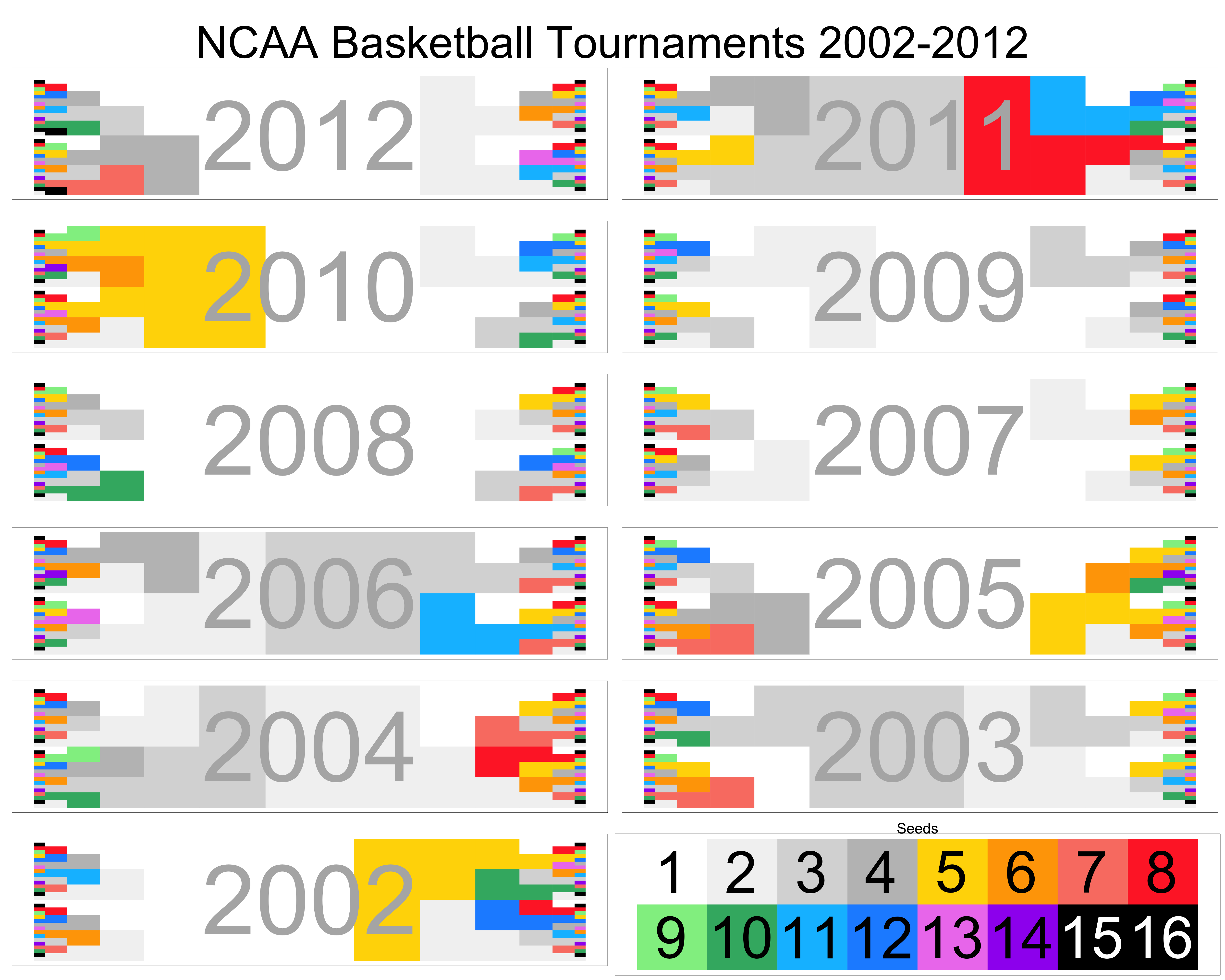
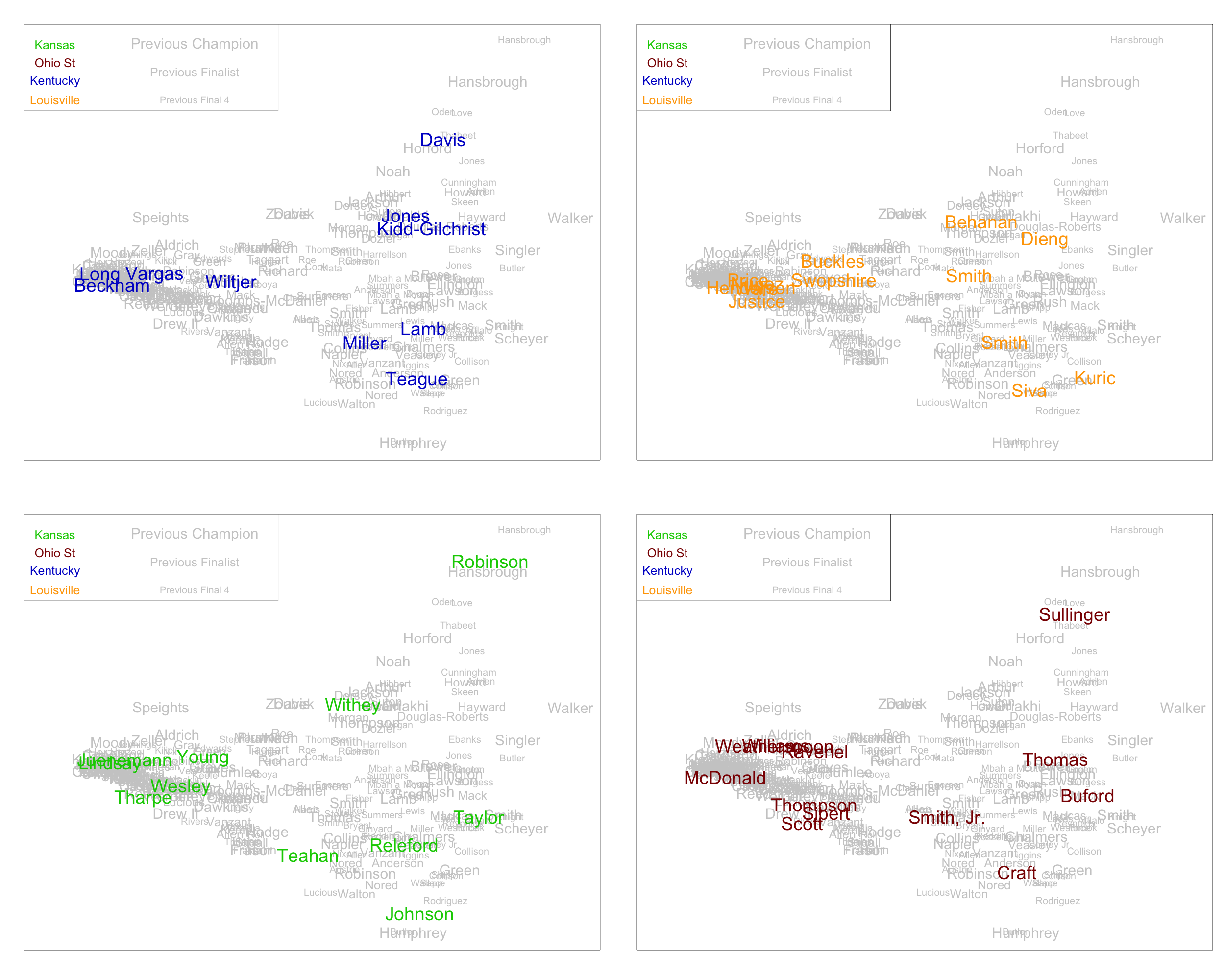
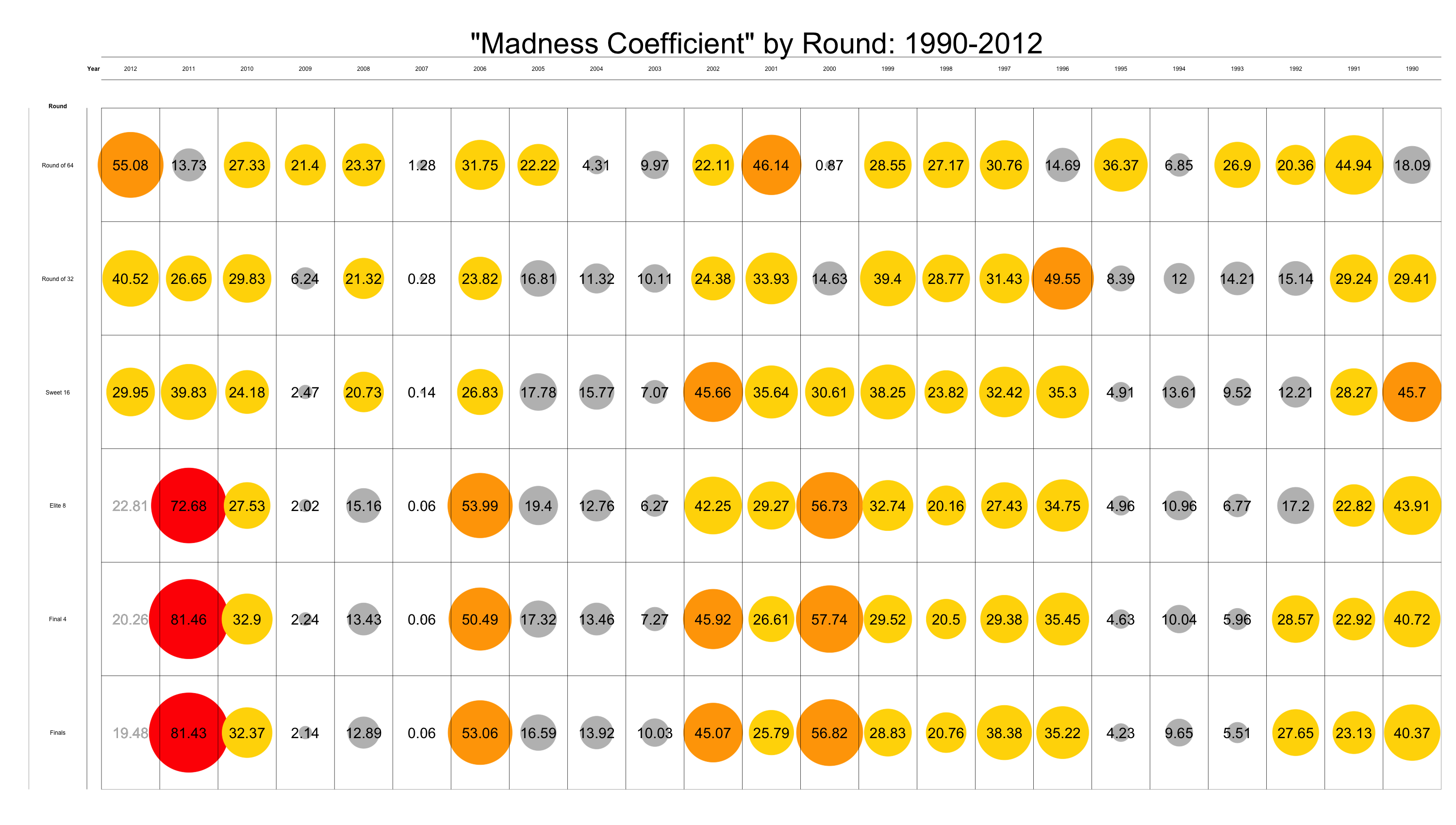
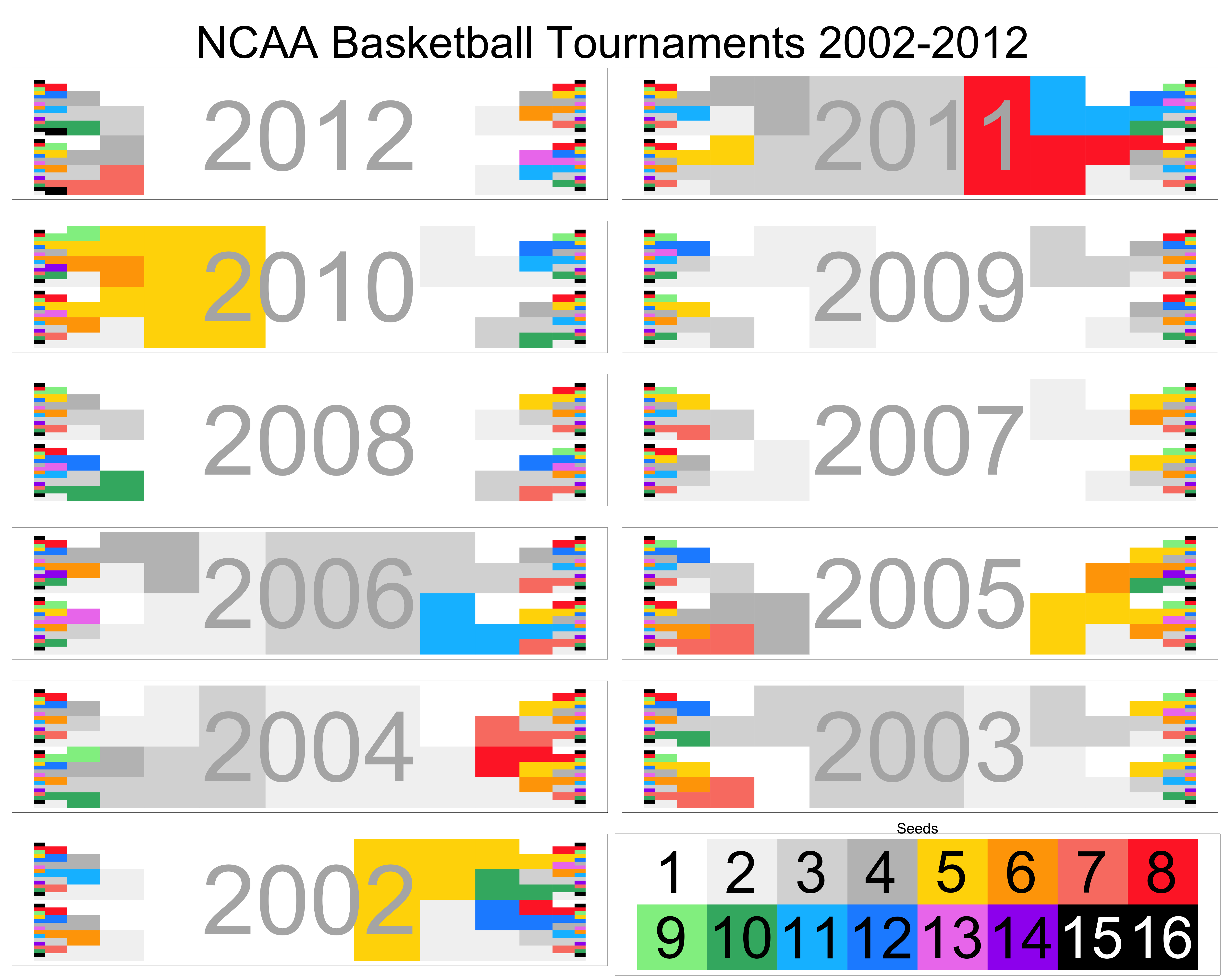
After the craziest start to the NCAA tournament in 20+ years, the madness has died down a bit. The Elite will feature three number 1 seeds, two number 2 seeds, a 3, 4, and a 7.
Cheers.
NCAA Basketball Tournament Classification Tree: In Review
My first round entry in the Stat Geek Idol contest was about using decision trees to predict teams that would make it to the Sweet Sixteen. Now that we are down to sixteen teams remaining in the tournament, let’s review how the model performed.
Let’s start out with what I consider to be the most impressive results. In the article, I stated, in the conclusion:
So the moral of the story is don’t get too excited about Florida State (even though they just won the ACC) or Michigan, and if you’re looking to pick an impressive upset, just about any of the fourteen seeds will do.
The second half of this sentence makes me look bad as I singled out the only seed other than 16 not to win a first round game. But I don’t think I was the only one to make this mistake. Plenty of people were really excited about Belmont. Alternatively, in the first half of the sentence I chose Florida State and Michigan as teams to not make it to the Sweet Sixteen based on the model results. Now, by itself, it’s not too impressive to pick a team to NOT make it to the Sweet Sixteen (just pick a 16 seed every year), but these were two teams that, if they only beat lower seeded teams were expected to make it to the Sweet Sixteen. Michigan lost in the Round of 64 and Florida State lost in the Round of 32 (after barely escaping the first round). This means that in the last six years no team with an overall RPI rating between 0.6169 and 0.643 with an opponent’s effective possession ratio greater than or equal to 0.9147 and an average second half scoring margin of less than 2.998 has ever made it to the Sweet Sixteen. These teams are 0 for 11. That’s kind of interesting.
Large RPI teams
In the article I said:
So what about this year teams? There are 6 teams in the tournament this year that fall into group R1. These teams are Kentucky (1), Michigan State (1), North Carolina (1), Syracuse (1), Kansas (2), and Duke (2). These are the high Overall RPI teams that almost always advance to the Sweet Sixteen.
Group R2 only contains one team this year, Ohio State (2). Recall that in the last five years, all nine of the teams from group R2 have advanced to the Sweet Sixteen.
Group R3, which has advanced 51.61% of the time over the past five years includes eight teams this year: Missouri (2), Marquette (3), Baylor (3), Georgetown (3), Louisville (4) [In the original article, I wrote eight teams and then only listed seven], Indiana (4), and Wichita State (5) and Memphis (8).
Group R4 consists of Florida State (3) and Michigan (4). No team from group R4 has advanced to the Sweet Sixteen in the last five years. We’ll see if either the Seminoles or the Wolverines can snap the losing streak for R4.
- Group R1 advanced 5 out of 6 (83.33%) teams this year with only Duke failing to make the Sweet Sixteen. Historically (previous five years), 91.17% of teams in this group advance to the Sweet Sixteen.
- Group R2 contained one team this year, Ohio State, and they did, in fact, advance to the Sweet Sixteen. Ohio State is now the tenth team to fall into this category over the last six years and all ten of these teams have qualified for the Sweet Sixteen.
- Group R3 had eight teams in it this year and historically 51.61% of teams in this group qualify for the Sweet Sixteen. This year 4 out of the 8 (50%) qualified. Marquette, Baylor, Louisville, and Indiana advanced while Missouri, Georgetown, Wichita State, and Memphis have been eliminated.
- Group R4, as previously mentioned, contained two teams this year and both failed to qualify for the Sweet Sixteen. In the last six years, no team from this group has ever made it to the Sweet Sixteen
Small RPI teams
In the article I said:
So what about the small RPI teams this year? The tournament this year features nine teams in the group L2. These teams include St. Mary’s (7), Florida (7), Notre Dame (7), Creighton (8), Purdue (10), California (12), South Dakota State (14), Belmont (14), and Iona (14).
The L3 group contains one team this year: BYU (14). 8 out of 12 teams in this group over the past five years have gone on to the Sweet Sixteen, however, BYU to the Sweet Sixteen this year seems unlikely as they are a 14 seed and have to win a play-in game just to get into the round of 64. I think it’s interesting that all these fourteen seeds fall into these categories with relatively high probabilities of advancing to the Sweet Sixteen.
All of the remaining teams fall into the L1 category, which has advanced a little over 5% of its teams to the Sweet Sixteen. Some of the notable teams that fall into this group include Wisconsin (4), New Mexico (5), Temple (5), Vanderbilt (5), Murray State (5), Cincinnati (6), UNLV (6), and San Diego State (6). Also, in this group are Gonzaga (7), Kansas State (8), Iowa State (8), Alabama (9), Saint Louis (9), UConn (9), and Southern Mississippi (9).
- Group L1 had 39 teams fall into this category (after the First Four had been played). Historically, 5.34% of these teams make it to the Sweet Sixteen. This year 5 out of 39 (12.82%) qualified. This is a little bit higher than usual and is reflected in just how crazy this tournament has been over the first two rounds. The teams that qualified from for the Sweet Sixteen from this group were Wisconsin, Cincinnati, Xavier, NC State, and Ohio.
- Group L2 had nine teams this year and historically 17.86% of these teams qualify for the Sweet Sixteen. Only one of these nine teams (11.11%), Florida, qualified for the Sweet Sixteen. Interestingly, two of these nine teams were knocked out in the First Four.
- Group L3 contained only one team, BYU. 8 of the 12 previous teams in the group qualified for the Sweet Sixteen, but with BYU’s loss, this group falls to 8 for 13 (61.5%)
Cheers.
 Stats in the Wild