Category Archives: Sports
MLB Ranking – 9/12/2012
StatsInTheWild MLB rankings as of September 11, 2012 at 12:18pm. SOS=strength of schedule
| Team | Rank | Change | Record | ESPN | TeamRankings.com | SOS | Run Diff |
| Texas | 1 | – | 83-57 | 2 | 1 | 11 | +116 |
| NYY | 2 | – | 79-61 | 8 | 3 | 5 | +92 |
| Tampa Bay | 3 | – | 77-63 | 9 | 5 | 7 | +78 |
| Washington | 4 | ↑1 | 87-54 | 1 | 4 | 25 | +132 |
| Oakland | 5 | ↓1 | 80-60 | 7 | 2 | 8 | +83 |
| LA Angels | 6 | – | 77-64 | 10 | 6 | 6 | +65 |
| Atlanta | 7 | ↑3 | 81-61 | 4 | 8 | 19 | +82 |
| Chi WSox | 8 | – | 76-64 | 11 | 10 | 14 | +62 |
| Baltimore | 9 | ↑2 | 78-62 | 5 | 7 | 3 | -22 |
| Cincinnati | 10 | ↓1 | 85-57 | 3 | 9 | 30 | +82 |
| Detroit | 11 | ↓4 | 73-67 | 12 | 11 | 13 | +32 |
| SF | 12 | ↑1 | 79-62 | 6 | 12 | 26 | +43 |
| St. Louis | 13 | ↓1 | 75-66 | 13 | 15 | 29 | +43 |
| Seattle | 14 | – | 67-74 | 19 | 13 | 2 | -20 |
| Toronto | 15 | ↑2 | 64-75 | 22 | 14 | 1 | -42 |
| Boston | 16 | ↓1 | 63-78 | 23 | 18 | 4 | -18 |
| LA Dodgers | 17 | ↓1 | 74-67 | 14 | 17 | 23 | +17 |
| Arizona | 18 | – | 69-72 | 18 | 20 | 24 | +26 |
| Philadelphia | 19 | ↑2 | 70-71 | 16 | 16 | 20 | -8 |
| Pittsburgh | 20 | ↓1 | 72-68 | 15 | 21 | 27 | 0 |
| Milwaukee | 21 | ↑1 |
70-71 | 17 | 22 | 28 | +33 |
| Kansas City | 22 | ↑1 | 63-77 | 24 | 19 | 12 | -45 |
| NY Mets | 23 | ↓3 | 65-76 | 21 | 24 | 15 | -46 |
| San Diego | 24 | – | 67-75 | 20 | 23 | 22 | -38 |
| Minnesota | 25 | – | 59-82 | 26 | 25 | 10 | -101 |
| Miami | 26 | – | 63-79 | 25 | 26 | 16 | -94 |
| Cleveland | 27 | – | 59-82 | 28 | 27 | 9 | -172 |
| Colorado | 28 | – | 57-83 | 27 | 28 | 17 | -96 |
| Chi Cubs | 29 | – | 55-86 | 29 | 29 | 21 | -121 |
| Houston | 30 | – | 44-97 | 30 | 30 | 18 | -204 |
Past Rankings:
Cheers.
MLB Playoff Probabilities – 9/12/2012
StatsInTheWild MLB rankings as of September 11, 2012 at 12:18pm. SOS=strength of schedule
| Team | Rank | Change | Record | Projected Record | Prob of making playoffs | SOS | Run Diff |
| Texas | 1 | – | 83-57 | 94-68 | 99.4% | 11 | +116 |
| NYY | 2 | – | 79-61 | 90-72 | 87.4% | 5 | +92 |
| Tampa Bay | 3 | – | 77-63 | 88-74 | 46.4% | 7 | +78 |
| Washington | 4 | ↑1 | 87-54 | 98-64 | 99.9% | 25 | +132 |
| Oakland | 5 | ↓1 | 80-60 | 90-72 | 74.7% | 8 | +83 |
| LA Angels | 6 | – | 77-64 | 86-76 | 25.0% | 6 | +65 |
| Atlanta | 7 | ↑3 | 81-61 | 91-71 | 99.6% | 19 | +82 |
| Chi WSox | 8 | – | 76-64 | 86-76 | 82.1% | 14 | +62 |
| Baltimore | 9 | ↑2 | 78-62 | 89-73 | 71.7% | 3 | -22 |
| Cincinnati | 10 | ↓1 | 85-57 | 95-67 | 99.9% | 30 | +82 |
| Detroit | 11 | ↓4 | 73-67 | 84-78 | 19.7% | 13 | +32 |
| SF | 12 | ↑1 | 79-62 | 89-73 | 98.6% | 26 | +43 |
| St. Louis | 13 | ↓1 | 75-66 | 84-78 | 47.7% | 29 | +43 |
| Seattle | 14 | – | 67-74 | 75-87 | 0% | 2 | -20 |
| Toronto | 15 | ↑2 | 64-75 | 74-88 | 0% | 1 | -42 |
| Boston | 16 | ↓1 | 63-78 | 72-90 | 0% | 4 | -18 |
| LA Dodgers | 17 | ↓1 | 74-67 | 83-79 | 25.0% | 23 | +17 |
| Arizona | 18 | – | 69-72 | 78-84 | 0.5% | 24 | +26 |
| Philadelphia | 19 | ↑2 | 70-71 | 80-82 | 2.2% | 20 | -8 |
| Pittsburgh | 20 | ↓1 | 72-68 | 82-80 | 24.9% | 27 | 0 |
| Milwaukee | 21 | ↑1 |
70-71 | 79-83 | 1.5% | 28 | +33 |
| Kansas City | 22 | ↑1 | 63-77 | 74-88 | 0% | 12 | -45 |
| NY Mets | 23 | ↓3 | 65-76 | 74-88 | 0% | 15 | -46 |
| San Diego | 24 | – | 67-75 | 75-87 | 0% | 22 | -38 |
| Minnesota | 25 | – | 59-82 | 68-94 | 0% | 10 | -101 |
| Miami | 26 | – | 63-79 | 71-91 | 0% | 16 | -94 |
| Cleveland | 27 | – | 59-82 | 68-94 | 0% | 9 | -172 |
| Colorado | 28 | – | 57-83 | 67-95 | 0% | 17 | -96 |
| Chi Cubs | 29 | – | 55-86 | 64-98 | 0% | 21 | -121 |
| Houston | 30 | – | 44-97 | 52-110 | 0% | 18 | -204 |
Cheers.
MLB Payroll vs Winning percentage
Dave Cameron over at FanGraphs wrote an interesting article about 2012 payroll and wins. In it, he used a scatterplot, which I assume was made with excel. I’d like to try to persuade everyone to stop making graphics in excel. I’m probably a little bit biased, but R with the ggplot2 package is much, much better. (And it’s easy!) I present to you below, my entire argument for why R with ggplot2 is better than excel:
Here is the code for making this graph
Cheers.
MLB Playoff Probabilities – 9/4/2012
StatsInTheWild MLB rankings as of September 4, 2012 at 12:18pm. SOS=strength of schedule
| Team | Rank | Change | Record | Projected Record | Prob of making playoffs | SOS | Run Diff |
| Texas | 1 | ↑1 | 80-54 | 95-67 | 99.3% | 11 | +121 |
| NYY | 2 | ↓1 | 76-58 | 90-72 | 87.4% | 6 | +86 |
| Tampa Bay | 3 | – | 74-61 | 87-75 | 43.4% | 7 | +78 |
| Oakland | 4 | ↑1 | 76-58 | 89-73 | 69.2% | 8 | +79 |
| Washington | 5 | ↓1 | 82-52 | 97-65 | 99.9% | 25 | +114 |
| LA Angels | 6 | ↑4 | 72-63 | 84-78 | 7.9% | 5 | +50 |
| Detroit | 7 | ↑2 | 72-62 | 86-76 | 53.8% | 13 | +37 |
| Chi WSox | 8 | ↓1 | 73-61 | 87-75 | 66.2% | 14 | +66 |
| Cincinnati | 9 | ↓1 | 82-54 | 95-67 | 99.9% | 30 | +84 |
| Atlanta | 10 | ↓4 | 76-59 | 89-73 | 96.0% | 22 | +82 |
| Baltimore | 11 | ↑1 | 75-59 | 88-74 | 72.8% | 3 | -31 |
| St. Louis | 12 | ↑1 | 70-64 | 85-77 | 44.5% | 29 | +97 |
| SF | 13 | ↑5 | 77-58 | 90-72 | 96.8% | 26 | +43 |
| Seattle | 14 | ↑1 | 66-70 | 77-85 | 0% | 2 | -9 |
| Boston | 15 | ↓4 | 62-74 | 73-89 | 0% | 4 | -9 |
| LA Dodgers | 16 | – | 73-63 | 85-77 | 34.4% | 24 | +28 |
| Toronto | 17 | ↓3 | 60-74 | 72-90 | 0% | 1 | -41 |
| Arizona | 18 | ↓1 | 66-70 | 76-84 | 0.1% | 23 | +23 |
| Pittsburgh | 19 | – | 70-64 | 84-78 | 27.4% | 28 | +9 |
| NY Mets | 20 | ↑1 | 64-71 | 76-86 | 0.1% | 15 | -28 |
| Philadelphia | 21 | ↑1 | 65-70 | 78-84 | 0% | 20 | -20 |
| Milwaukee | 22 | ↑3 | 65-69 | 77-85 | 0.7% | 27 | +19 |
| Kansas City | 23 | ↓3 | 60-74 | 73-89 | 0% | 12 | -56 |
| San Diego | 24 | ↑3 | 62-74 | 73-89 | 0% | 21 | -56 |
| Minnesota | 25 | – | 55-80 | 67-95 | 0% | 10 | -106 |
| Miami | 26 | – | 60-75 | 71-91 | 0% | 16 | -96 |
| Cleveland | 27 | ↓4 | 57-78 | 68-94 | 0% | 9 | -157 |
| Colorado | 28 | ↑1 | 55-78 | 67-95 | 0% | 18 | -95 |
| Chi Cubs | 29 | ↓1 | 51-83 | 63-99 | 0% | 19 | -115 |
| Houston | 30 | – | 42-93 | 52-110 | 0% | 17 | -197 |
Cheers.
MLB rankings – 9/4/2012
StatsInTheWild MLB rankings as of September 4, 2012 at 12:18pm. SOS=strength of schedule
| Team | Rank | Change | Record | ESPN | TeamRankings.com | SOS | Run Diff |
| Texas | 1 | ↑1 | 80-54 | 3 | 1 | 11 | +121 |
| NYY | 2 | ↓1 | 76-58 | 4 | 3 | 6 | +86 |
| Tampa Bay | 3 | – | 74-61 | 9 | 5 | 7 | +78 |
| Oakland | 4 | ↑1 | 76-58 | 5 | 2 | 8 | +79 |
| Washington | 5 | ↓1 | 82-52 | 2 | 4 | 25 | +114 |
| LA Angels | 6 | ↑4 | 72-63 | 13 | 7 | 5 | +50 |
| Detroit | 7 | ↑2 | 72-62 | 12 | 9 | 13 | +37 |
| Chi WSox | 8 | ↓1 | 73-61 | 10 | 10 | 14 | +66 |
| Cincinnati | 9 | ↓1 | 82-54 | 1 | 8 | 30 | +84 |
| Atlanta | 10 | ↓4 | 76-59 | 8 | 11 | 22 | +82 |
| Baltimore | 11 | ↑1 | 75-59 | 7 | 6 | 3 | -31 |
| St. Louis | 12 | ↑1 | 70-64 | 11 | 14 | 29 | +97 |
| SF | 13 | ↑5 | 77-58 | 6 | 12 | 26 | +43 |
| Seattle | 14 | ↑1 | 66-70 | 18 | 13 | 2 | -9 |
| Boston | 15 | ↓4 |
62-74 | 21 | 16 | 4 | -9 |
| LA Dodgers | 16 | – | 73-63 | 15 | 15 | 24 | +28 |
| Toronto | 17 | ↓3 | 60-74 | 23 | 17 | 1 | -41 |
| Arizona | 18 | ↓1 | 66-70 | 16 | 21 | 23 | +23 |
| Pittsburgh | 19 | – | 70-64 | 14 | 18 | 28 | +9 |
| NY Mets | 20 | ↑1 | 64-71 | 20 | 22 | 15 | -28 |
| Philadelphia | 21 | ↑1 |
65-70 | 17 | 19 | 20 | -20 |
| Milwaukee | 22 | ↑3 | 65-69 | 19 | 23 | 27 | +19 |
| Kansas City | 23 | ↓3 | 60-74 | 24 | 20 | 12 | -56 |
| San Diego | 24 | ↑3 | 62-74 | 22 | 24 | 21 | -56 |
| Minnesota | 25 | – | 55-80 | 26 | 25 | 10 | -106 |
| Miami | 26 | – | 60-75 | 25 | 27 | 16 | -96 |
| Cleveland | 27 | ↓4 | 57-78 | 28 | 26 | 9 | -157 |
| Colorado | 28 | ↑1 | 55-78 | 27 | 28 | 18 | -95 |
| Chi Cubs | 29 | ↓1 | 51-83 | 29 | 29 | 19 | -115 |
| Houston | 30 | – | 42-93 | 30 | 30 | 17 | -197 |
Past Rankings:
Cheers.
NFL Week 1 predictions
Week 1 (11-5 SU, 9-7 ATS, 8-8 O/U)
Wednesday @8:30pm
Dallas Cowboys at New York Giants
Prediction: Dallas wins 24-23
Pick: Cowboys +3.5
O/U: Over 47
Sunday @1pm
Indianapolis Colts at Chicago Bears
Prediction: Indianapolis wins 22-21
Pick: Colts +10
O/U: Over 41.5
Philadelphia Eagles at Cleveland Browns
Prediction: Eagles win 24-16
Pick: Eagles -8.5
O/U: Under 41
Buffalo Bills at New York Jets
Prediction: Jets win 23-20
Pick: Jets -3
O/U: Over 41
Washington Redskins at New Orleans Saints
Prediction: Saints win 28-17
Pick: Saints -9.5
O/U: Under 49.5
New England Patriots at Tennessee Titans
Prediction: Patriots win 27-20
Pick: Patriots -6.5
O/U: Under 47.5
Jacksonville Jaguars at Minnesota Vikings
Prediction: Vikings win 23-20
Pick: Jaguars +4.5
O/U: Over 38
Miami Dolphins at Houston Texans
Prediction: Texans win 23-21
Pick: Dolphins +9.5
O/U: Over 43
St. Louis Rams at Detroit Lions
Prediction: Lions win 21-16
Pick: Rams +9
O/U: Under 46.5
Atlanta Falcons at Kansas City Chiefs
Prediction: Falcons win 24-17
Pick: Falcons -1
O/U: Under 41.5
Sunday @4:25pm
Seattle Seahawks at Arizona Cardinals
Prediction: Cardinals win 22-19
Pick: Cardinals +1.5
O/U: Under 40.5
San Francisco 49ers at Green Bay Packers
Prediction: Packers wins 27-19
Pick: Packers -5.5
O/U: Over 45
Carolina Panthers at Tampa Bay Buccaneers
Prediction: Panthers wins 21-20
Pick: Buccaneers +2.5
O/U: Under 46.5
Sunday @8:20
Pittsburgh Steelers at Denver Broncos
Prediction: Steelers win 23-20
Pick: Steelers Even
O/U: Under 44
Monday @7pm
Cincinnati Bengals at Baltimore Ravens
Prediction: Ravens win 23-18
Pick: Bengals +6
O/U: Over 40.5
Monday @10:15pm
San Diego Chargers at Oakland Raiders
Prediction: Chargers win 27-19
Pick: Chargers -1.5
O/U: Under 47.5
Cheers.
NFL preview
Season Preview
It’s almost here! Another season of grown men smashing their brains together for our entertainment. And entertained we will be.
So, let’s start at the end: which teams are most likely to be suffering life-lengthening (Not really) massive head injuries in February 2013 in New Orleans? I’m once again making a not so bold prediction and taking Green Bay over New England in the Super Bowl this year.
Some Comments
AFC
East
New England has the easier road to New Orleans of the two by playing the softest regular season schedule of any team this year. For starters, they play in the AFC east which features Buffalo, Miami, and the New York Jets. None of those teams had winning records last year, and they all failed to make the playoffs. The Patriots then go on to play the AFC South and the NFC West. The teams in these two divisions had a combined record of 56-72 last year. In fact, they play only 3 games all of 2012 against teams that had winning records in 2011. If they beat baltimore in week 3, they could very reasonably be 8-0 at their bye week. If they start the first half of their season any worse than 6-2, it’s a disaster.
The Jets, Dolphins, and Bills are good teams, but none of them are very good teams. They all get screwed annually by having to play New England twice every single year.
North
I always feel bad for the wild card team that always seems to come out of this division. You win 11+games and, not only do you not get a bye week, you have to go ON THE ROAD to play some crap team from the AFC west after they “earned” home field advantage. (What I’m saying is that Pittsburgh should not have had to go to Denver last year.)
I think Pittsburgh wins this division in a close race by either one game or in a tie-breaker with Baltimore. The season’s biggest game outside the division is Baltimore’s game against New England. Pittsburgh avoids having to play the Patriots this year and that might just be enough to get them the division title.
South
Texans.
West
Any of these teams has a legitimate shot to limp to a division title and playoff game (at home!). I think San Diego wins it this year thanks to a much, much easier schedule than division foe Denver, who is the most likely team to challenge for the division. Denver’s first 8 opponents all had at least 8 wins last year, and six of those 8 went to the playoffs. Good luck Peyton. Any of the four teams could realistically win this division, and there is a chance they could do it 2010 Seattle Seahawks style. The AFC West drew the AFC North and the NFC South this year on their schedule. So they’ll have to play Pittsburgh, Baltimore, Cincinnati, New Orleans and Atlanta: All 2011 playoff teams. At least they all get to console themselves with the statement “Hey, at least we get to play [Insert AFC West team] twice”. My dream is to see a team a 6-10 team make the playoffs and this year’s schedule and division of mediocrity are certainly keeping my hopes alive.
NFC
East
New York, Dallas, or Philadelphia has a real chance to win this division this year, but I think the Eagles get it done. I thought the Eagles were the best team in this division last year, and I think they’re the best team in the division again. It also helps that they have the easiest schedule of any of the teams that have a legitimate chance to win the division (Washington does not).
North
Green Bay wins the division by at least two games. The interesting question is who finishes second. I’m taking Detroit as runner-up and earning a wild card spot and 5th seed in the NFC.
South
I think New Orleans is going to win this division again, but Atlanta will make it close. I’ll pick Atlanta to get the second wild card because I have to pick someone. But there are at least 6 other teams that have a real shot at it (New York, Dallas, Chicago, Carolina, Seattle, Arizona).
West
San Francisco is too talented to not win this division again, but I think it’ll be a lot closer than a lot of people are making it out to be. I think the real question in this division is can two teams get to the playoffs. Two years ago, this division was been all-time bad (they sent a 7-9 team to the playoffs!), but it was much more competitive in 2011.
Seattle has 11 games in 2012 against teams that were 8-8 or worse in 2011. If they can manage a winning record in those 11 games and pick up a few quality wins they can make a nice little run at the wildcard, but their going to have to earn it. They aren’t getting into the playoffs this year thanks to an easy schedule. They play San Francisco in Seattle on December 23 and could prove to be a critical game for both teams.
Arizona also has a very difficult schedule. They play games at New England, at Green Bay, at Atlanta, and at San Francisco. I’d be surprised if they won any of these games, and I’d be stunned if they won 2 or more. Unfortunately, this tough schedule probably leaves them out of the playoffs.
2012 Pre-Season Rankings
| Team | Rank | Ex W | SOS | SB Odds | WSEX odds | 2011 Wins |
| Green Bay | 1 | 11.17 | 23 | 6.7-1 | 6-1 | 15 |
| New England | 2 | 10.68 | 32 | 7.7-1 | 7-1 | 13 |
| New Orleans | 3 | 10.47 | 24 | 9.1-1 | 15-1 | 13 |
| San Francisco | 4 | 10.18 | 10 | 9.4-1 | 13-1 | 13 |
| Baltimore | 5 | 9.73 | 7 | 11.5-1 | 17-1 | 12 |
| Pittsburgh | 6 | 9.85 | 22 | 15.3-1 | 15-1 | 12 |
| Detroit | 7 | 9.15 | 12 | 21-1 | 30-1 | 10 |
| Houston | 8 | 9.15 | 29 | 18-1 | 10-1 | 10 |
| Atlanta | 9 | 9.00 | 30 | 27-1 | 25-1 | 10 |
| Philadelphia | 10 | 8.56 | 11 | 30-1 | 12-1 | 8 |
| Cincinnati | 11 | 8.54 | 19 | 38-1 | 45-1 | 9 |
| New York (G) | 12 | 8.01 | 1 | 44-1 | 17-1 | 9 |
| Chicago | 13 | 8.31 | 13 | 42-1 | 23-1 | 8 |
| San Diego | 14 | 8.44 | 26 | 40-1 | 25-1 | 8 |
| New York (J) | 15 | 8.09 | 15 | 54-1 | 32-1 | 8 |
| Seattle | 16 | 7.91 | 5 | 87-1 | 65-1 | 7 |
| Tennessee | 17 | 8.06 | 18 | 54-1 | 90-1 | 9 |
| Dallas | 18 | 7.85 | 6 | 35-1 | 25-1 | 8 |
| Miami | 19 | 7.79 | 21 | 53-1 | 110-1 | 6 |
| Arizona | 20 | 7.33 | 2 | 103-1 | 80-1 | 8 |
| Denver | 21 | 7.25 | 4 | 115-1 | 20-1 | 8 |
| Oakland | 22 | 7.49 | 27 | 77-1 | 100-1 | 8 |
| Carolina | 23 | 7.35 | 20 | 115-1 | 45-1 | 6 |
| Buffalo | 24 | 7.24 | 28 | 142-1 | 65-1 | 6 |
| Kansas City | 25 | 7.01 | 31 | 146-1 | 50-1 | 7 |
| Washington | 26 | 6.52 | 17 | 350-1 | 70-1 | 5 |
| Jacksonville | 27 | 6.41 | 14 | 710-1 | 160-1 | 5 |
| Cleveland | 28 | 6.17 | 8 | 1000-1 | 200-1 | 4 |
| Minnesota | 29 | 6.20 | 9 | 4501-1 | 180-1 | 3 |
| Tampa Bay | 30 | 5.70 | 25 | 2500-1 | 100-1 | 4 |
| St. Louis | 31 | 5.17 | 3 | 2500-1 | 110-1 | 2 |
| Indianapolis | 32 | 5.22 | 16 | 1600-1 | 120-1 | 2 |
Ex W – Average number of wins a team would have if the season was played 100,000 times.
SOS (Strength of schedule) – The average of the strength coefficients for each opponent on a team’s schedule.
SB Odds – SITW estimated odds that the team wins the Super Bowl
WSEX Odds – http://www.wsex.com odds to win Super Bowl
Predicted Standings for 2012 Season
Team: Predicted Record (Prob Make Playoffs, Super Bowl Wins Odds)
AFC East
- New England Patriots: 11-5 (85.44%, 7.7-1)
- New York Jets: 8-8 (37.3%, 54-1)
- Miami Dolphins: 8-8 (34.84%, 53-1)
- Buffalo Bills: 7-9 (26.38%, 142-1)
AFC North
- Pittsburgh Steelers: 10-6 (65.96%, 15.3-1)
- Baltimore Ravens: 10-6 (68.52%, 11.5-1)
- Cincinnati Bengals: 9-7 (41.86%, 38-1)
- Cleveland Browns: 6-10 (7.1%, 1000-1)
AFC South
- Houston: 9-7 (68.54%, 18-1)
- Tennessee: 8-8 (33.04%, 54-1)
- Jacksonville: 6-10 (11.12%, 710-1)
- Indianapolis Colts: 5-11 (4.24%, 1600-1)
AFC West
- San Diego Chargers: 8-8 (40.48%, 40-1)
- Oakland Raiders: 7-9 (26.82%, 77-1)
- Denver Broncos: 7-9 (26.84%, 115-1)
- Kansas City Chiefs: 7-9 (21.52%, 146-1)
NFC East
- Philadelphia Eagles: 9-7 (49.38%, 30-1)
- New York Giants: 8-8 (41.42%, 44-1)
- Dallas Cowboys: 8-8 (41.4%, 35-1)
- Washington Redskins: 7-9 (13.54%, 350-1)
NFC North
- Green Bay: 11-5 (87.42%, 6.7-1)
- Detroit: 9-7 (52.74%, 21-1)
- Chicago: 8-8 (38.22%, 42-1)
- Minnesota: 6-10 (6.7%, 450-1)
NFC South
- New Orleans: 10-6 (75.2%, 9.1-1)
- Atlanta: 9-7 (50.36%, 27-1)
- Carolina: 7-9 (18.08%, 115-1)
- Tampa Bay: 6-10 (3.16%, 2500-1)
NFC West
- San Francisco: 10-6 (75.68%, 9.4-1)
- Seattle: 8-8 (24.26%, 87-1)
- Arizona: 7-9 (20.44%, 103-1)
- St. Louis: 5-11 (2%, 2500-1)
Predicted Playoffs for 2012 Season
AFC
- New England
- Pittsburgh
- Houston
- San Diego
- Baltimore
- Cincinnati
Houston and Baltimore advance out of the wild-card weekend. This creates a New England vs Baltimore match-up, once again demonstrating why it might be better to be the two seed, as Pittsburgh gets a weaker opponent in Houston. New England and Pittsburgh advance with New England representing the AFC in the Super Bowl.
NFC
- Green Bay
- New Orleans
- San Francisco
- Philadelphia
- Detroit
- Atlanta
San Francisco and Detroit advance to the divisional round of the playoffs where San Francisco would play New Orleans in a rematch of a very exciting playoff game from last year. Green Bay beats Detroit and advance to the NFC championship game where they play New Orleans. Green Bay then defeats New Orleans to go to the Super Bowl.
Super Bowl
Green Bay defeats New England in the Super Bowl.
Mere Mortals: Retract this article
It seems I can’t stop writing about Bill Barnwell (here, here, and here) and his article, Mere Mortals, which presents “evidence” that baseball players who played during the years 1959 through 1988 have a higher mortality rate than football players. it seemed immediately obvious to me when I read the article that the two groups he was comparing were not directly comparable, and it seemed likely that the difference in mortality rates was probably due to differences in ages between the cohort, rather than the sport itself. Up to this point, however, I was just making well educated guesses as to how to explain the results.
So, I went and collected data myself and ran a quick analysis to check. The findings? When age is added to a model predicting death, the effect of the sport on mortality rate completely disappears. This means that if two players are the exact same age and one played professional football and the other played professional baseball for at least five years and one of those years was between 1959 and 1988 there is no evidence that the football player nor the baseball player is more likely to be deceased.
Data collection
Football
Using R, I scraped http://www.football-almanac.com to get a list of players names. I then used this list of players names to scrape http://www.pro-football-reference.com to get information about each players date of birth, age at death (if they have died), the start and end years of their careers, height, and weight. (A note about a shortcoming of my data collection for football: If a player had the same name as another player, I only collected one. I believe this is a small issue and will not affect the overall results, but it is worth noting.) In total, the football player data set had 14, 396 players.
Baseball
Using R, I scraped http://www.baseball-almanac.com to get a list of players names. I then used this list of players names to scrape http://www.baseballl-reference.com to get information about each players date of birth, age at death (if they have died), the start and end years of their careers, height, and weight. For baseball players, I was able to collect all players, including those who had the same name as another player. In total, the baseball player data set had 5,587 players.
Time Frame
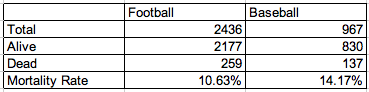
Both the baseball and football data sets were whittled down to only consider players who played at least five seasons and any of those seasons fell between 1959 and 1988. (These are slightly different standards than in the Barnwell article, but, again, the larger point should remain the same.) This left 2,436 football players and 967 baseball players. The mean age of baseball players in my sample was 64.19 while the mean age of football players was 60.91. (Barnwell tweeted that the difference in ages between his two groups, which were defined slightly differently, was about 24 months.) The mean ages of my two groups is significantly different with a p-value of <0.00000000000001. That’s a big deal.
The distributions of the ages of the football and baseball players is displayed below using a density estimator in R. You’ll notice that there are many more young players in the football group than in the baseball group. This indicates that mortality rates cannot be compared directly to one another as is done in the Barnwell article.
Think for a minute about the graph below. Without knowing anything about which color represents which sport, which of these two groups should have a higher mortality rate? (Hint: The blue one)

Analysis
Fisher Exact Test
259 out of the 2436 qualifying football players was deceased according to http://www.pro-football-reference.com for a mortality rate of 10.63%. Among baseball players, 137 out of 967 were dead for a mortality rate of 14.17%. Both of these rates are lower than Barnwell’s, but are of similar relative magnitudes. Using a Fisher exact test, the null hypothesis of no association is rejected with a p-value of 0.004407, which is essentially identical to Barnwell’s p-value of 0.004. So there is a statistically significant difference between these groups. That’s a fact. But….
Logistic Regression
This type of analysis estimates the probability of a certain event, in this case, death, while taking into account multiple factors that could be related to the event. Running a logistic regression model with death as an outcome and only sport as a dummy variable predictor yields a p-value of 0.00384 for the significance of sport being associated with death. This is largely the same result as the Fisher exact test as neither are controlling for any other variables besides sport.
When age, actually, it’s technically years since birth since some people are deceased, is added to the model, the effect of sport disappears entirely. The p-value for age is 
Conclusions and Future work
To reiterate, what we can conclude from this is that if two players are the exact same age and one played professional football and the other played professional baseball for at least five years and one of those years was between 1959 and 1988 that neither the football player nor the baseball player is more likely to be deceased.
The purpose of this work is to demonstrate that the conclusions reached in Barnwell’s article Mere Mortals is at the very least misleading. The author makes the case that baseball players are dying more often than football players. While it is true that baseball players from this time period are more likely to be deceased than their football counterparts, I have demonstrated that it is not BECAUSE they played baseball, rather it is their age, a pretty serious risk factor for death, that is a more significant predictor of being deceased.
I think a more interesting analysis than the one presented here by myself would be to look at survival times after retiring from each of the sports looking at risk factors including age, BMI, and years in the respective league.
A Final Request
Is it possible that baseball players die at a younger age than football players? I suppose it is possible, but I think it’s unlikely. What is for sure is that Bill Barnwell’s article, due to the flawed application of statistical methods, does not in any way demonstrate that baseball players are dying more often than football players. I believe it to be irresponsible to present work which falsely understates the potential dangers of playing football especially with the recent concussion and CTE studies involving NFL players. Therefore, I am requesting that Bill Barnwell openly retract his article, Mere Mortals, in writing on Grantland.com due the major statistical flaws of the study.
Mere Mortals: What I learned by comparing the mortality rates of baseball players and their Supreme Court counterparts
Bill Barnwell demonstrated what many are calling a stunning result when he showed that the mortality rate of baseball players was actually higher than that of football players who played at least five seasons during the years 1959 through 1988. How can this be explained? Especially with all of the recent news about head injuries and player suicides in football. Football sure seems like it should be more dangerous. But the comparison of baseball players to football players doesn’t make any sense to me. I think a better comparison is baseball players and Supreme Court justices. Football players are in peak physical condition during their playing days, whereas Supreme Court justices just sit and wait. Their levels of physical activity are probably more comparable to that of a baseball player standing and waiting for something to happen. Then, after all that waiting in the Supreme Court, a high profile case come along and raises stress levels. Similarly, baseball players, after long periods of waiting in games, must sprint all out at certain times. In this way, the healthcare hearings in the Supreme Court are very much like hitting a double or a triple in baseball. These similarities make comparing baseball players to Supreme Court justices more “apples to apples” than baseball to football players.
The methodology
I’ll be using the same methodology in Barnwell et al. to compare mortality rates.
Justice/Player Pool
Since, data on baseball players has already been collected, there is no need to collect the data again. I will include any Justice in the pool who served at least one year between 1959 and 1988. This includes Tom C. Clark, Earl Warren, John Marshall Harlan II, William J. Brennan, Charles Evans Whitaker, Potter Stewart, Byron White, Arthur Goldberg, Abe Fortas, Thurgood Marshall, Warren E. Burger, Harry Blackmun, Lewis F. Powell, Jr., William Rehnquist, John Paul Stevens, Sandra Day O’Connor, Antonin Scalia, and Anthony Kennedy.
The Findings

That’s correct: Supreme court justices who served any years between 1959 and 1988 died at a much higher rate than baseball players from the same time frame. The difference between the two is statistically significant and allows us to reject the nul hypothesis. Therefore, there is a meaningful difference between the mortality reates of baseball players and supreme court justices.
The 95% confidence interval for baseball players is 14.1% to 17.8% and for the Supreme court justices it is 58.6% to 96.98% and the p-value for the Fisher exact test is .000224! Highly significant.
Conclusions
Football is safer than baseball, and baseball is safer than the serving on the Supreme Court. So, why is it that Supreme Court justices from the ’60s, ’70s, and ’80s are dying more frequently than baseball players from the same era? Well, in the words of Barnwell:
Truthfully, as a layman, I can’t say with any certainty, and I don’t think it’s appropriate to speculate.
Cheers?
 Stats in the Wild