20K!
Unfortunately, I missed it, but StatsInTheWild officially hit the 20,000 views all-time three days ago on June 17, 2012. Congratulations to me.
Cheers.
AL East
Just a reminder that all five of the teams in the American League East have positive run differentials. That’s one of many reasons why it’s insane that ESPN has Toronto and Boston ranked 15 and 17 in their power rankings.

I like my rankings or these rankings much better because it appears that some actual thought was put into them beyond just “put the team with the most wins at the top”. Do you really think the Pirates are better than the Red Sox?
Cheers.
ggplot2!
So I had lunch today with two stats post-docs, and the R package ggplot2 came up. So I started dabbling and here is my first graph. It’s the same as my one-hitter graph, but instead it was made with ggplot2. I think it looks a bit more professional.

Cheers.
Strikeouts on the rise
Someone recently mentioned to me that strikeouts in the major leagues were at an all time high. So I did what anyone would naturally do: Write some R code to scrape baseball-reference.com, collect team data for every team over the past 112 years, and plot it. The results are below:

Things to notice:
- The strikeout rate for the first 15 years of the 20th century was relatively flat at around 10%.
- There have been two major drops in strikeout rates. The first was from about 1915 through 1920, the second was between the late 1970s through 1980.
- The first drop in strikeout rates was around the beginning of Babe Ruth’s when power hitting became a more prominent part of the game.
- The second major drop followed a rules change where the mound was lowered from 15 inches to 10 inches for the 1969 season.
- These two small periods of rapid decline were both followed by long stretches of slowly increasing strikeout rates. Strikeout rates steadily climbed from about 1920 through the mid-1960s, and then again from 1980 to present.
- In 1973 the American League introduced the designated hitter (DH). Before 1973, the American and National leagues had very similar strikeout rates. After 1973, one can see a clear separation of the leagues as the National league, not surprisingly, has had a higher strikeout rate than the American league every year since the beginning of the DH era.
- The team with the highest strikeout rate in the last 112 years was the 2010 Arizona Diamondback who finished 65-97 with a strikeout rate of nearly 25%. Before 1980, the team with the highest strikeout rate was the 1968 New York Mets.
- The team with the lowest strikeout rate of the last 20 years was the 2002 Anaheim Angels who won the World Series that year. Since the mound was lowered, the 1980 Texas Rangers have the distinction of having the lowest strikeout rate for a season. The lowest strikeout rate for any team since 1901 was the 1901 Boston Americans with a strike out rate just over 5%
Cheers.
Does Your Writing Style Have a Fingerprint? (via Slate)
Here is an excerpt from Slate.com‘s lexicon valley:
Is it possible that your writing style is identifiably unique? In the late 1800s, a Polish philosopher named Wincenty Lutosławski imagined a “future science of stylometry,” whereby the singular style of an author could be quite literally measured. In such a future, controversies over authorship would be resolved not by literary scholars but by statisticians, and data would provide the answer. Sounds like pie in the sky, right? But it turns out that Lutosławski was right. Over the past 50 years, stylometrists have fashioned a promising way to identify authorial signatures using something called “lexical glue.” Listen as Bob Garfield and I talk about how a bunch of seemingly inconspicuous words actually stand out.
It’s almost as if statistics is everywhere. Oh wait. It is…
Cheers.

 Last night, my dear friend George Casella passed away, after a long illness he had fought with his usual determination and optimism. Having known George for 25 years, I am devastated… He was a great father / friend / collaborator / researcher / teacher / editor / runner, and, above all, a great and unique person. The loss is profound, the loss is significant, for me and for us… My thoughts go out to his wife, Anne, and children, Benjamin and Sarah, who are the ones to feel this loss the most keenly.
(The following is adapted from a recommendation letter George asked me to write when he was considering moving to the University of Florida, Gainesville, from Cornell, a task for which I considered myself completely inadequate. I just hope it carries some of the love and admiration I felt for George.)
To me, George was the…
View original post 518 more words
More one-hitters
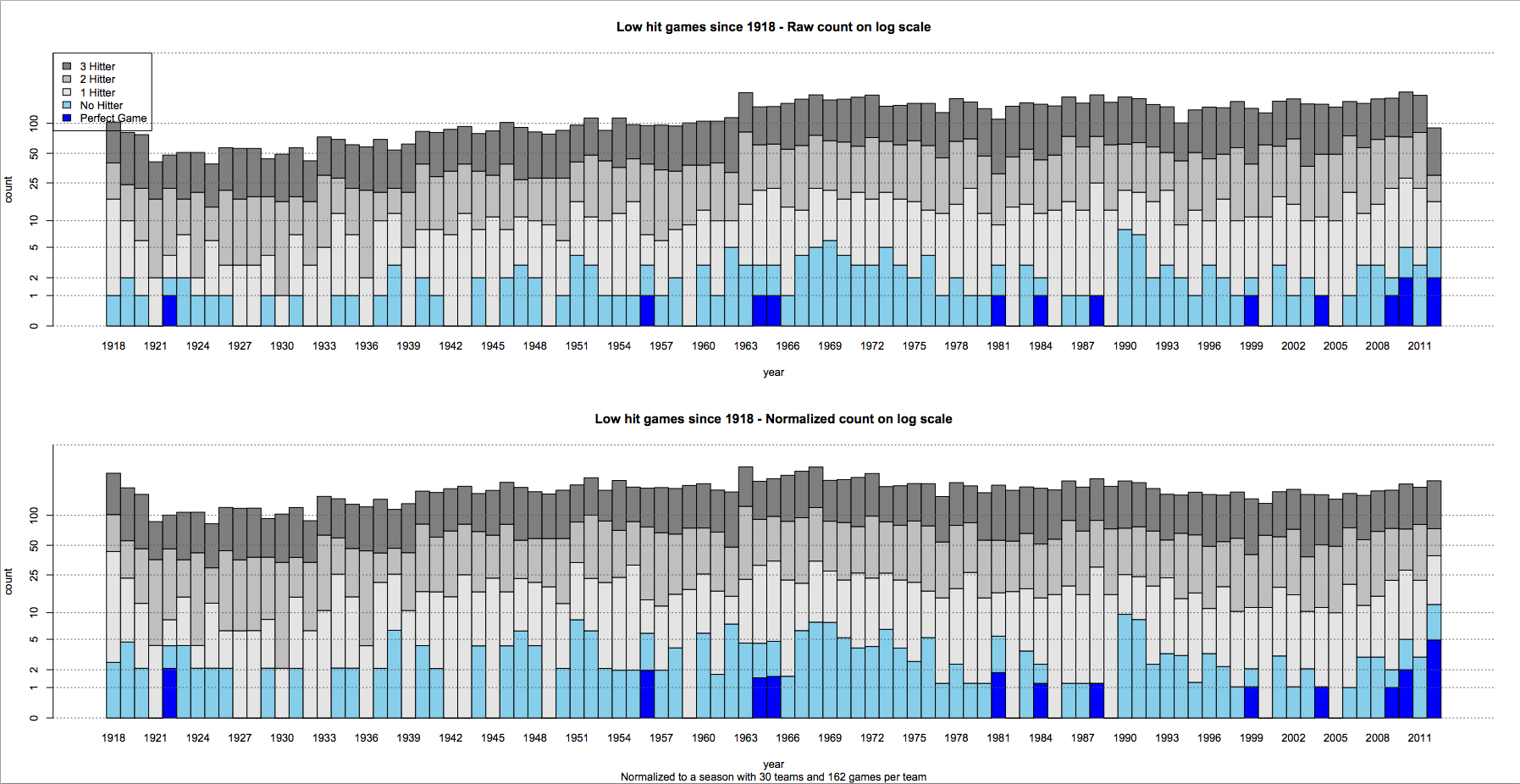
R.A. Dickey just pitched his second consecutive one-hitter, which is just the latest feat in what is rapidly becoming the season of the pitchers. So far this season 9 guys other than Dickey have pitched a one-hittter (E.Santana, Cain, Verlander, Moore, Hammel, CJ Wilson, Vogelsong, Duffy, Felix Hernandez), which brings the total to 11 one-hitters so far this season as of June 19. This season has also featured 3 no-hitters (Jered Weaver, Johan Santana, and Millwood et al.) and 2 perfect games (Phil Humber and Matt Cain). So far, in total, there has been 16 games with one or fewer hits. (Let me remind you that it’s June 19). To compare, here is a list of complete seasons that had fewer than 16 low hit games: 2008 (15), 2007 (12), 2005 (10), 2004 (11), 2003 (10), 2002 (15), 2000 (11), 1999 (11), 1998 (10), 1996 (10), 1995 (13). That’s 11 out of the last 17 seasons. To re-iterate, in 7 of the last 11 completed seasons, their were fewer one hit or fewer games pitched during the entire season than have already been pitched so far in 2012.
Here is an updated graph for June 19th to include the latest one-hitters by Hammel and Dickey.

I’ve also created a graph looking at all games with fewer than 4 hits since 1918 (Note that this graph is on a log-scale).
Cheers.
MLB Rankings – 6/19/2012
StatsInTheWild MLB rankings as of June 19, 2012 at 10:37am. SOS=strength of schedule
| Team | Rank | Change | Record | ESPN | TR | SOS |
| NYY | 1 | ↑1 | 41-25 | 2 | 1 | 5 |
| Texas | 2 | ↓1 | 41-27 | 4 | 3 | 13 |
| Tampa Bay | 3 | – | 37-29 | 7 | 4 | 2 |
| Baltimore | 4 | ↑4 | 39-28 | 18 | 2 | 3 |
| Toronto | 5 | ↓1 | 34-33 | 15 | 8 | 1 |
| Boston | 6 | ↓1 |
33-33 | 17 | 10 | 4 |
| LA Angels | 7 | ↑4 | 36-32 | 10 | 9 | 8 |
| LA Dodgers | 8 | ↑1 | 42-25 | 1 | 7 | 29 |
| Washington | 9 | ↓3 | 38-26 | 3 | 5 | 20 |
| ChiSox | 10 | ↓3 |
35-32 | 11 | 13 | 14 |
| Cincinnati | 11 | ↑2 | 38-28 | 6 | 6 | 30 |
| Oakland | 12 | ↑8 | 31-36 | 21 | 21 | 28 |
| Detroit | 13 | ↑8 | 32-34 | 20 | 17 | 11 |
| Atlanta | 14 | ↓4 |
35-32 | 9 | 11 | 17 |
| St. Louis | 15 | ↓3 |
34-33 | 12 | 18 | 28 |
| SF | 16 | ↑2 | 38-30 | 8 | 15 | 27 |
| NY Mets | 17 | ↓1 | 36-32 | 13 | 12 | 16 |
| Cleveland | 18 | ↓4 | 34-32 | 14 | 16 | 12 |
| Seattle | 19 | ↓4 |
29-40 | 25 | 24 | 6 |
| Arizona | 20 | ↑2 | 33-34 | 19 | 19 | 24 |
| Kansas City | 21 | ↑2 | 29-36 | 24 | 22 | 10 |
| Philadelphia | 22 | ↓3 |
31-37 | 22 | 23 | 18 |
| Pittsburgh | 23 | ↑1 | 34-31 | 16 | 14 | 26 |
| Miami | 24 | ↓7 | 33-33 | 18 | 20 | 15 |
| Milwaukee | 25 | – | 31-36 | 23 | 25 | 25 |
| Minnesota | 26 | ↑2 |
26-39 | 27 | 27 | 9 |
| Houston | 27 | ↓1 | 28-39 | 26 | 26 | 23 |
| Colorado | 28 | ↓1 | 25-40 | 28 | 28 | 21 |
| Chic Cubs | 29 | – | 23-44 | 30 | 30 | 22 |
| San Diego | 30 | – | 24-44 | 29 | 29 | 19 |
Past Rankings:
Cheers.
 Stats in the Wild