A novel way to gamble on the NCAA tournament…
I saw a talk at JSM where I was introduced to a fun new (well, new to me) game to play during the NCAA tournament. First, teams are assigned a price based on their seed. This can be done in many ways, but it was set in the talk that the one seeds cost 25 cents, the two seeds cost 19 cents, all the way down to the 15 and 16 seeds which were a penny each. The goal is to choose a set of teams, that costs, in total, one dollar, that will win the most number of games in the NCAA tournament. So picking all the number one seeds, which will cost exactly one dollar, but the most wins they can earn is 19 (4 each to the final four and then one each for the two semifinals and one for the championship). So, according to the speaker, this usually won’t get you the win. First of all, this game is awesome. Once you can stop thinking about how awesome this game is, the next logical question is: How do you choose the optimal set of teams?
Douglas Noe and his student Geng Chen used an evolutionary algorithm to optimize the selection of teams, and they used Ken Pomeroy’s rankings as a guide to the probability that one team will beat another team in the tournament. Now, I don’t think I ever heard of evolutionary algorithms, and, if I have, I’ve totally forgotten about them. But they are wicked cool. Here is the wikipedia page for evolutionary algorithms, and it’s worth checking out. Does anyone have any suggestions as to a good resource for an introduction to evolutionary algorithms?
Cheers.

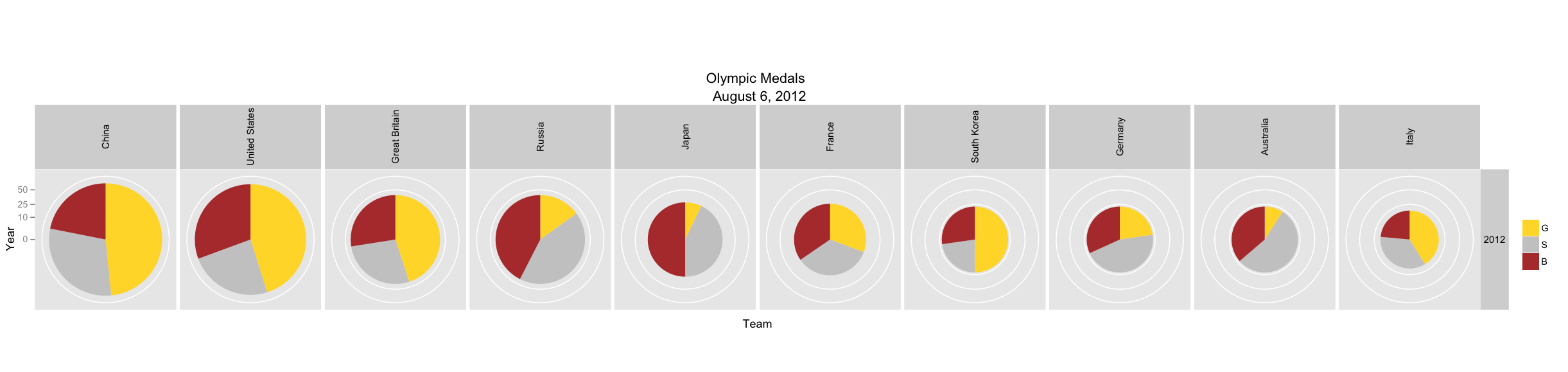
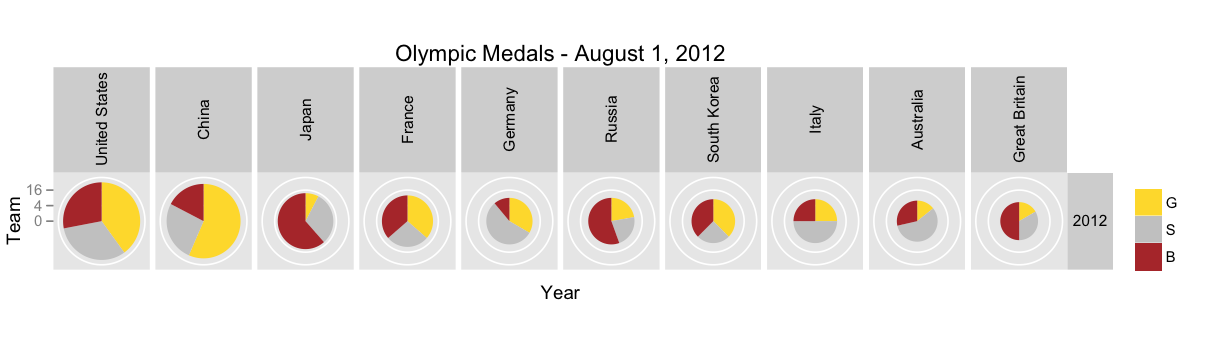
Which country wins the Olympics? Right now China is in the lead for most medals (73: 34 gold, 21 silver, 18 bronze) and most golds. The USA is second in both categories (71: 30 gold, 19 silver, 22 bronze). In 2008 there was some controversy about whether the ranking should be done by largest total number of medals or largest golds; here’s the table from Wikipedia. If I recall correctly (though it’s surprisingly hard to search for this) non-Americans were saying that the “right” way to do it is by golds, but Americans insisted on doing it by total medals. Not surprisingly the USA had the most total medalists in ’08 (110, to China’s 100) but not the most golds (36, to China’s 51).
But it hardly seems fair to expect, say, France to get as many medals as the USA, simply because they have about one-fifth the population…
View original post 516 more words

MLB Rankings – 8/6/2012
StatsInTheWild MLB rankings as of August 6, 2012 at 8:17pm. SOS=strength of schedule
| Team | Rank | Change | Record | ESPN | TeamRankings.com | SOS | Run Diff |
| NYY | 1 | – | 63-44 | 3 | 1 | 5 | +92 |
| Texas | 2 | – | 63-44 | 4 | 2 | 13 | +83 |
| LA Angels | 3 | – | 58-51 | 9 | 6 | 7 | +49 |
| Washington | 4 | ↑2 | 65-43 | 2 | 4 | 23 | +82 |
| ChiSox | 5 | ↑4 | 59-48 | 7 | 5 | 14 | +64 |
| Cincinnati | 6 | ↑5 | 66-42 | 1 | 3 | 29 | +72 |
| Oakland | 7 | ↑1 | 58-50 | 8 | 7 | 8 | +28 |
| Detroit | 8 | ↓1 | 58-50 | 13 | 9 | 12 | +24 |
| TampaBay | 9 | ↑1 | 56-52 | 14 | 12 | 3 | +19 |
| Atlanta | 10 | ↑5 | 62-46 | 5 | 8 | 21 | +62 |
| Boston | 11 | ↓6 | 54-55 | 17 | 13 | 6 | +29 |
| Toronto | 12 | ↓8 | 53-55 | 18 | 14 | 2 | +9 |
| St. Louis | 13 | ↑1 | 59-49 | 10 | 15 | 30 | +110 |
| Baltimore | 14 | ↓2 | 57-51 | 16 | 11 | 1 | -57 |
| Pittsburgh | 15 | ↓2 |
61-46 | 6 | 10 | 28 | +36 |
| Seattle | 16 | ↑1 | 51-59 | 20 | 17 | 4 | -3 |
| Arizona | 17 | ↑4 | 55-53 | 15 | 19 | 26 | +42 |
| SF | 18 | ↓2 | 59-49 | 11 | 16 | 27 | +19 |
| LA Dodgers | 19 | ↓1 |
59-50 | 12 | 18 | 25 | +15 |
| NY Mets | 20 | – | 53-56 | 19 | 20 | 17 | -5 |
| Minnesota | 21 | ↑3 | 47-61 | 25 | 22 | 11 | -79 |
| Kansas City | 22 | – | 45-62 | 26 | 23 | 10 | -60 |
| Cleveland | 23 | ↓4 | 50-58 | 21 | 21 | 9 | -90 |
| Milwaukee | 24 | ↓1 | 48-59 | 22 | 26 | 19 | -13 |
| Philadelphia | 25 | – | 49-59 | 24 | 24 | 19 | -29 |
| Miami | 26 | – | 49-60 | 23 | 25 | 15 | -100 |
| Chic Cubs | 27 | ↑1 | 43-63 | 28 | 27 | 18 | -79 |
| San Diego | 28 | ↓1 | 46-64 | 27 | 28 | 22 | -61 |
| Colorado | 29 | – | 38-68 | 29 | 29 | 20 | -117 |
| Houston | 30 | – | 36-73 | 30 | 30 | 16 | -142 |
Past Rankings:
Cheers.

Bad Badminton
I read this story about some badminton players that were thrown out of the Olympics for intentionally losing a match. In the words of Deadspin:
The Chinese team of Wang Xiaoli and Yu Yang and South Koreans Jung Kyung-eun and Kim Ha-na played a farce of a match in which players served into the net on purpose or lazily launched shots out of bounds. The Chinese players’ incentive to lose was a bracket placement that would keep them on the opposite side from the other top-ranked Chinese team, meaning they’d avoid facing them until the finals. The Koreans, having sensed the plot from Wang and Yu, attempted to lose themselves in response.
Wait. What? They were trying to lose the match on purpose to avoid playing a team that they didn’t want to play until the finals? That seems like a totally rational thing to do. The goal at the Olympics is to win a medal. The goal is not to get as high a seed as possible coming out of pool play. If you don’t want situations like this then, don’t play this format. Sure, they were throwing the game, but they weren’t involved in a betting scandal or anything. They were losing on purpose to give themselves, in their minds, the largest probability to win a medal. Isn’t that the rational thing to do if your goal is to win a medal? And the goal is to win medals, right? Right?
Now, you could look at this as China colluding to try to maximize the number of medals they can win. By avoiding each other in the elimination rounds until the finals, they avoid eliminating each other from medal contention. This might be frowned upon, but again, isn’t it the rational thing for the Chinese team to do? I guess “always trying your hardest” is more of an Olympic ideal than “doing the rational thing”.
Cheers.

 Stats in the Wild